


This is a post written by Mark Herringer, the Director at Konektaz open development initiative. It originally appeared here and has been republished with permission from the author.
We are living in a new world. This world is driven by connection to one another and data that we generate. As a result we have opportunities to collaborate and find innovative solutions to long standing challenges. A key ingredient to this collaboration is open data. Understanding where we are now and what we have done to date is crucial in understanding what to do next. This empirical open collaborative process is an opportunity that open data presents. It is one of the reasons why Barack Obama issued an Executive Order — Making Open and Machine Readable the New Default for Government Information.
Accurate well maintained open data shows us where we are now and invites collaboration and participation in getting to where we want to be.
What is open data?
“Open data is data that can be freely used, reused and redistributed by anyone – subject only, at most, to the requirement to attribute and sharealike.” OpenDefinition.org
- open data is a list of pharmaceuticals accessed by procurement officers in Southern Africa
- open data is the Geolocation of schools, hospitals and health clinics
- open data is the Geolocation of places and things in Openstreetmap
For social change to take place technology needs to be appropriate and rooted in local knowledge. Sokari Ekine – SMS Uprising
Primary Health Care organisations working in communities and engaging citizens through Health Care specialists have insights and knowledge regarding the needs of the community. These insights together with the open data collected through a mobile device can spark the development of valuable products and services by social entrepreneurs. The insight regarding what is needed is what guides development and the focus of open data. #opendatademand has been established.
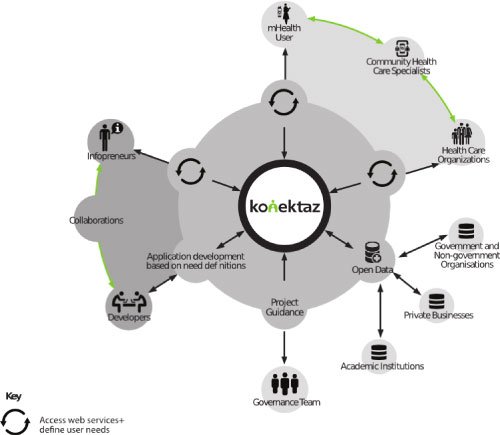
How do we spark engagement by Social Entrepreneurs?
Social Entrepreneurs can be incentivised through social bonds. A social bond works in a similar way to Kickstarter. A Bond is paid out when the social target is reached. Let’s say the number of women in an area who have enrolled their children at the local school. A baseline is established and then the intervention is made. The number is measured and when reached the bond is paid.
When you combine this with an open development approach where organisations share knowledge and development progress you have a potent combination for communities to act.

Recently I attended the Global Conference on Citizen Engagement for Enhanced Development Impact #engagevoices
Some of the learnings from the day included the following barriers to citizen engagement:
- Citizens lack incentives to participate – bring on the social bond and allow me to engage
- Citizens lack meaningful opportunity to participate – allow me to participate through my phone
- Governments lack capacity to listen – make it easy for us to see what you are saying
- Governments lack incentives to change – show us how you improve our business case to deliver services
The Internet and social media allows us to share knowledge and insight at the click of a button. Social organisations sharing their knowledge and insights allow social entrepreneurs to engage. By linking Social Bonds to development outcomes social entrepreneurs can find innovative methods to make use of open data and achieve development goals and the needs of the community instead of waiting for service delivery from the Government and aid organisations.
When Primary Health Care organisations release service and outcome data it can be linked and analysed in ways that will better inform the delivery of care and services. Patients, academics, data intermediaries and other organisations can access the data and make comparisons that enable more informed choices.
To achieve this collaboration, organisations need to release their data under an open data licence. Once the data is published under an open data license it is interoperable with other open data.
A great example of this is that of the The Clinton Health Access Initiative (CHAI). Using credible medicines forecasting models and open data on pricing and suppliers, CHAI has been able to pre-negotiate significantly lower pricing deals on antiretroviral (ARV) medicines that countries are able to access. This information is being used to set ceiling prices for the South Africa ARV Tender and this is expected to reduce the total cost of ARVs to the South African Government by up to $100 million per annum. By publishing open data the ARV purchasing officers of Southern African countries were able to achieve economies of scale and a competitive market price.
Opportunities for mHealth
Primary health care organisations that share knowledge and open data and development progress regarding the communities they serve have an opportunity to:
- identify social needs
- improve service delivery
- support innovation
- create employment
Next steps
- As a Primary health care organisation get an open data policy established
- Identify what you should/could be publishing and make it available
- Define your objectives through a development dashboard and publish your results
- Establish a Social Bond element to the organisation that incentivises social entrepreneurs
As June Jordan wrote in her poem for South African women We are the ones we’ve been waiting for
Photos: Courtesy of the author.