


‘’Polio is a crippling and potentially fatal infectious disease. There is no cure, but there are safe and effective vaccines. The strategy to eradicate polio is therefore based on preventing infection by immunizing every child until transmission stops and the world is polio-free.’’[1]
Since 1988, polio cases have decreased by 99%, and in 2010, there were fewer than 1500 cases worldwide. Yet despite this tremendous progress, polio persists in about a dozen countries in sub-Saharan Africa and South Asia.[2]
Angola has been appointed as one of the top fastest growing economies worldwide for the last decade, thanks to its key asset – the peace process. Demand pops up from everywhere, including infrastructure build and rebuild, and economic and social ones. However, while Angola’s economy is growing, the country also suffers from one of the highest infant mortality rate in the world. Nearly one in five babies won’t live to be a year old, the reason being that vaccines to protect these children from terrible diseases, such as polio, aren’t reaching them.
As mentioned in a post from the Bill & Melinda Gates Foundation, “Polio has re-emerged as a threat within Angola. Areas considered polio-free as recently as 2005 experienced a significant outbreak in 2010. While the country started an aggressive vaccination campaign to stop the disease from spreading, more remains to be done.”
Movicel, one of Angola’s mobile operators and a pioneer in 4G network in Africa, is part of a nominated list of key organizations to help reconstruct Angola. On top of the operator’s sound corporate results, Movicel made the decision to massively support two initiatives in Angola: education and public health. With its public health initiative, Movicel provided support for a polio vaccination campaign.
Vaccination campaigns always have a challenging key point – encouraging people to get inoculated. To be considered successful, a polio campaign has to reach high levels of presence, near 95%, and that level can be quite hard to achieve, due to the transportation, communication and other issues that may prevent people from getting inoculated.
In Benguela Province, a prime focus for the polio vaccination campaign, Movicel supported the program by offering participants a mobile top-up for each vaccinated child. As a result, the statistics showed more than 100% attendance, ensuring the success of the campaign. Following this outcome in Benguela, other provinces have requested Movicel’s support, not only in polio vaccination campaigns, but also for tetanus vaccinations, which are aimed at pregnant women.
As stated by its CEO, Yon Moreira, through their efforts,” Movicel has shown the role that mobile operators can play in vaccination campaigns and disease prevention. In Angola, the value of operators and the importance of their significant reach into rural geographic areas have allowed them to deploy mHealth services to otherwise unreached people”.
Nevertheless even though the need exists and the operators have the strength to meet it, the GSMA is still seeing fragmentation across different markets, and is hoping to reduce this with its new Pan African mHealth Initiative.
Pan African mHealth Initiative – creating opportunities for health and mobile
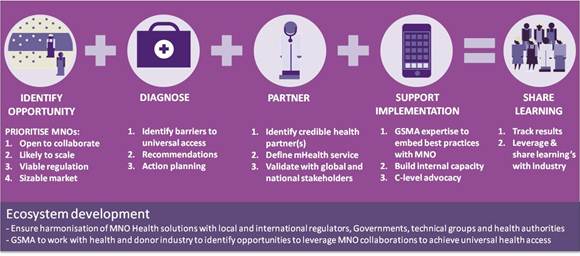
Pan African mHealth Initiative Objectives:
- Reduce fragmentation of mHealth services by creating opportunities for mobile operators to collaborate and impact universal healthcare access (scale and adoption of services)
- Increase mHealth technical and commercial interoperability between mobile operators, other “m” services and health systems (sustainability)
- Align health and mobile industries around common goals (value propositions) and reduce barriers preventing the sustainable and scaled integration of mobile into health
[1] http://www.polioeradication.org
[2] Bill & Melinda Gates Foundation