


The embryonic nature of mHealth in developing nations has led stakeholders to concentrate on advocacy, content development and the challenges of accessing end users, many of whom are at the base of pyramid and may not have access to a device with an executable environment (able to use rich services) or at all.
These are fundamental challenges and important to fixate upon, but by focusing attention upon them exclusively the wider issues of business sustainability and scaling are neglected. The results of such a strategy are well documented but the most serious is the failure of potentially successful initiatives that simply collapse when funding runs out.
Mobile Business Proposition
The strategies to overcome these challenges are also well known; excite and motivate MNOs by providing a comprehensive mHealth product proposition and motivate government budget holders by demonstrating the cost savings and efficiencies of exploiting mHealth. However, while the challenges are known the process to overcome them is not.
To provide a viable, sustainable and scalable product proposition one needs to first identify a business opportunity. In many of the developing nations where mHealth could have the greatest impact a commercial B2C proposition is currently not an option. In these markets players are competing for a very small underdeveloped customer segment; effectively fighting over pennies. As such there is little motivation for MNOs. In such a scenario B2B becomes a more attractive proposition, particularly if an MNO can provide mobile health services to a government or a government health department. The challenge resides in broadcasting the efficiencies and advantages mHealth can provide, in particular efficiencies around complying to regulation, including protection of patient data and ensuring services delivered are robust and/or produce cost savings.
The various players involved in provisioning the mHealth service also require justifications for involvement. In the case of MNOs this is a ready-made business opportunity and ideally some advantage in its broader strategic aims. For the facilitators of mHealth services including VAS providers, aggregators, content developers and the like there is the need for a prescribed revenue model in which they are remunerated for their activities preferably in a structured and timely manner. This is a particular issue based on the hand-to-mouth type of existence of many of these players.
While these are a daunting set of challenges they can be tackled by exploiting the unique service attributes of a GSMA led initiative known as IP Exchange (IPX). IPX is a model for the exchange of IP based traffic between customers of mobile and fixed networks. It was not designed as a mHealth platform but has a number of characteristics that lend themselves to solving some of the problems around mHealth product development.
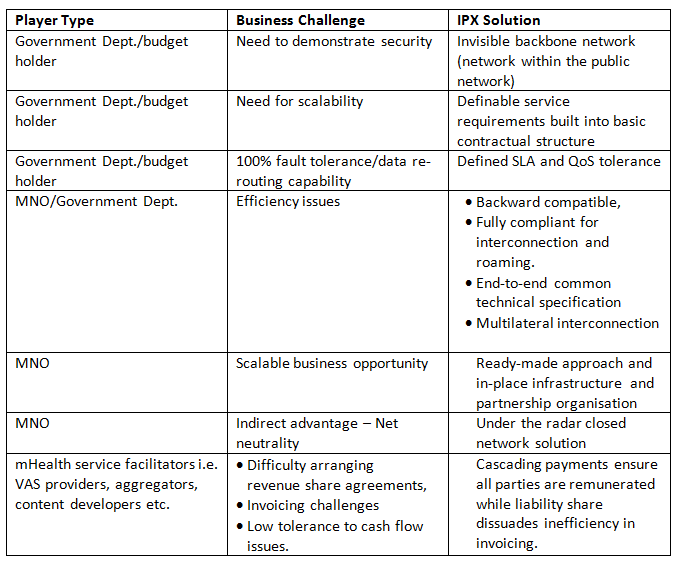
As a private backbone network IPX resides within the public network, while at the same time being independent from it. Due to this an IPX network is completely secure (not addressable or visible from the internet). In addition, the IPX standard incorporates a defined QoS and guaranteed contractually enforceable SLA as standard requisites of any IPX network agreement. It is fully backward compatible which would be important for interconnection with legacy networks and fully compliant for interconnection and roaming. In addition, there is a common end-to-end technical specification and any operator connected to an IPX network can choose a multilateral interconnection mode where one interconnection contract opens multiple interconnection partners.
These capabilities fulfil the requirements for security, fault-tolerance, defined performance and efficiency, both in connecting across technologies, network topologies and technical standards.
IPX also leverages cascading payments; a system whereby each member of an IPX transit is liable for the performance of the next in the chain. This means all members of the value chain must make a financial commitment and/or receive commercial remuneration for their participation (revenue share). Again this is a requisite requirement of a standard IPX network arrangement.
This provides a solution of sorts for the various value chain players by defining and requiring a revenue share in an organised and timely manner.
The business efficacy of IPX from the MNO perspective is fairly clear: a pre-existing solution with a prescribed role to provide a privatised mHealth secure network; a ready-made B2B business opportunity than can be pitched to governments. But there is a further and more strategic advantage.
Operators are keen to investigate closed network models as a counterpoint to net neutrality. There is ongoing debate surrounding this issue and legislative interest with strong lobby groups for and against. An IPX network is effectively a closed network as the specific requirements it offers must be agreed within a contractual framework and paid for; performance related payment. As such a health-related IPX network would effectively be a closed network benefiting broadband mobile network operators.
Summary of IPX Network capabilities in relation to mHealth
Concluding Points
Ultimately the B2B approach scales by providing end users with an introduction to mHealth that over time normalises the idea of mobile devices providing health services. This normalising feature allows mHealth to migrate toward a B2C business opportunity, as mHealth comes to occupy the role of favoured health facilitator that end users would be willing to pay for.
For more information on the GSMA Mobile for Development mHealth, please contact us on mhealth@gsma.com. For information on various mHealth initiatives, click here. For more information on GSMA mHealth resources, click here.