Mobile and digital technologies are transforming the humanitarian landscape by improving aid delivery, extending reach to last-mile communities, and strengthening coordination between humanitarian actors. This blog explores three partnerships between the mobile industry and humanitarian organisations in Burundi, facilitated by the GSMA. These initiatives have leveraged mobile technology to support communities by delivering cash assistance, improving access to maternal healthcare information, and enabling secure digital payments.
Meeting urgent humanitarian needs in Burundi
Burundi is experiencing widespread challenges driven by displacement, food insecurity, and climate-related shocks. With over 1.8 million people in need of humanitarian assistance, aid organisations face mounting pressure to respond rapidly and at scale. Since 2019, the GSMA Mobile for Humanitarian Innovation (M4H) programme has been supporting tech-enabled responses in the country through user research, stakeholder engagement, and strategic partnerships.
The programme has brought together mobile ecosystem actors Econet Wireless Burundi and Sasai Fintech, and a wide range of humanitarian organisations – including the World Food Programme (WFP), the United Nations High Commissioner for Refugees (UNHCR), the International Rescue Committee (IRC), the Burundi Red Cross, the World Bank (Merakabandi Project), Caritas, WV International, Concern Worldwide, Christian Aid, Pathfinder International and the United Nations Office for the Coordination of Humanitarian Affairs (OCHA).
By embedding mobile-enabled solutions into humanitarian programming, these partnerships are driving real impact for communities across Burundi – as the following three initiatives show.
1. Digital cash assistance through mobile money
Traditionally, cash-based assistance programmes in Burundi have relied on the physical distribution of cash – a method that can be costly, time-consuming, and vulnerable to fraud. To address these challenges, Econet Wireless Burundi and Sasai Fintech partnered with WFP Burundi to deliver mobile-enabled cash transfers to communities in the provinces of Karusi, Kirundo, Rutana and Ruyigi.
Between October 2024 and March 2025, the initiative reached over 10,854 households with pregnant and lactating women, with further plans to scale to 110,000. To support the transition to mobile money, WFP provided digital financial literacy training to help recipients use the service with confidence, make informed financial decisions, take advantage of economic opportunities, and protect themselves from fraud.
The programme also helped increase awareness of consumer rights by strengthening both digital and financial literacy. For WFP, the shift to mobile-enabled transfers has improved transparency and traceability while reducing operational costs – creating a more efficient and secure system for delivering ongoing support.
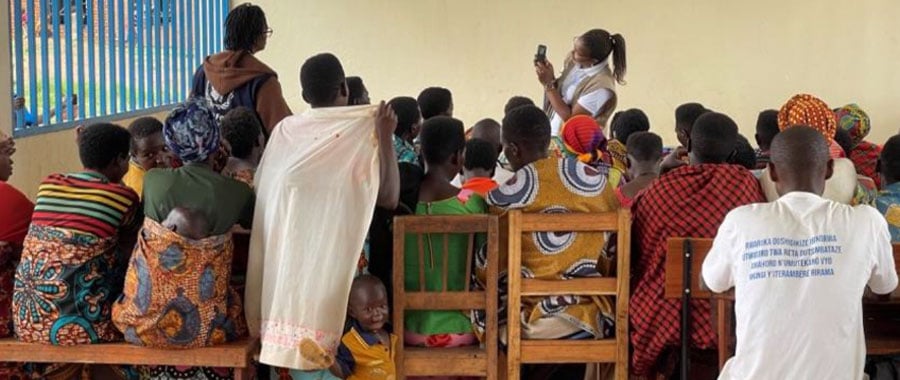
Digital and financial literacy training conducted by WFP, December 2024
2. Mobile-enabled maternal healthcare
Limited access to healthcare and low awareness of maternal health services contribute to high maternal and infant mortality rates in Burundi. To help address these challenges, the GSMA partnered with Pathfinder International to digitise maternal health outreach using an SMS-based health information platform and a toll-free line.
Pregnant women and new mothers received essential health messages and could connect with medical professionals remotely. In Karusi province alone, over 168,000 women received SMS-based maternal health information, with 29,000 messages sent weekly between November 2024 and March 2025. This regular engagement improved awareness and health-seeking behaviours, contributing to increased antenatal care attendance and more facility-based deliveries.
The initiative was enabled by cross-sector collaboration: Econet Wireless Burundi provided the network access and SMS infrastructure; Pathfinder International developed the health content and ensured its alignment with existing maternal health programmes; and Sasai Fintech supported platform delivery. This partnership approach helped extend access to essential health information and reinforced connections between communities and healthcare services.
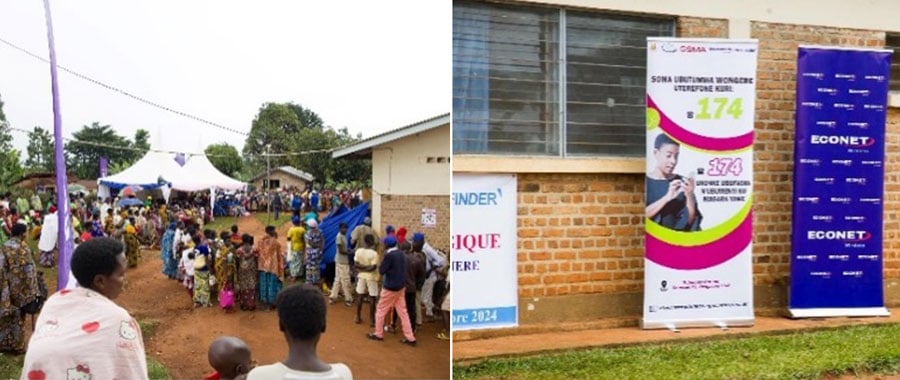
Community engagement led by Pathfinder International, November 2024
3. Enabling secure and efficient e-payments
In humanitarian contexts, manually distributing cash and voucher assistance (CVA) can be slow, labour-intensive, and difficult to scale. World Vision International Burundi, in collaboration with the GSMA, introduced a digital e-payment platform to streamline and strengthen this process.
The platform improved the speed, transparency, and accountability of CVA, while also promoting financial inclusion by connecting recipients to mobile payment systems and supporting longer-term economic participation.
Econet Wireless Burundi provided the mobile infrastructure that powered the platform, while World Vision International Burundi led implementation and community engagement. Together, they helped establish a more reliable and scalable approach to delivering assistance.
Looking ahead
From mobile money to digital health and e-payments, these partnerships illustrate how collaboration between mobile ecosystem actors and humanitarian organisations can build more effective and resilient humanitarian systems. For mobile operators and fintech providers, these engagements also create new opportunities to reach underserved populations.
GSMA’s M4H programme will continue to foster partnerships that expand the reach of digital solutions and strengthen humanitarian response. We welcome collaboration with partners committed to using innovation to better serve communities in crisis.