


This is a guest post written by Julia Lee from Microfinance Opportunities.
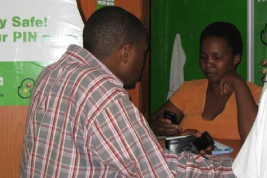
Robert is a mobile money agent in Ghana. He tries to teach his customers how to use their cell phones to perform seemingly straight forward transactions: check account balances, deposit money and transfer cash. But unfortunately, Robert ends up exactly where he started: with the client’s cell phone in his hand performing transactions on behalf of his clients.
Robert’s clients are far from alone. In 2010 and 2011, Microfinance Opportunities conducted market research in India, Philippines, Zambia and Malawi with low-income consumers to identify the challenges they faced in adopting mobile money. The qualitative market research study consisted of 66 focus group discussions with active and non-active clients and 75 individual in-depth interviews with consumers, agents, merchants and bank staff. Trust was the major common hurdle—consumers had limited trust in the technology to keep their money safe. Asked to leapfrog into a new financial world, consumers also lacked the confidence to use this technology correctly having also a limited understanding on the full range of mobile money products on offer or their associated benefits.
Consumers’ apprehension with mobile money had much to do with the “paperless” nature of the technology. Without a physical receipt for a mobile money transaction, customers worried about the safety of their money. Moreover, without a clear understanding of the safeguards in place for mobile money, e.g. PIN and SMS confirmations, and who is accountable should problems arise, the perceived risks outweigh the benefits.
The second key challenge was customers’ limited understanding of how to conduct transactions themselves. They worried that a simple error in transacting could be a costly one for them. Clients who attempt a transaction and fail may stop using the service altogether. Alternatively, clients who rely too heavily on agents to perform their transactions, in some cases, supplying the agents with their PINs, are vulnerable to theft.
Consumer education can play a role in bridging the gap between consumer trust and adoption of mobile money. Education can help clients overcome the trust hurdle by teaching them how mobile money works and how to use it themselves.
In order to do this, consumer education first needs to understand where the clients currently are in their knowledge and experience with using mobile money. This may involve looking at what the clients’ level of experience is with formal financial services and even their experience with using mobile phones.
The next step is explaining how the service can benefit them. This is more than just awareness raising. It is about deepening people’s understanding about how mobile money can help solve concrete financial stress points in their lives and better manage their money.
Take for example in the Philippines where a worker receives his monthly salary through his mobile money account. Indicative of his level of trust in the service, he withdraws his entire salary from his account every month. However, he ends up spending it all, with no money set aside in case of emergencies. Consumer education can help him think about different ways the mobile money account could better serve him. For example, he could leave the bulk of his salary in his mobile money account so that he doesn’t have a large sum of cash at hand and isn’t tempted to spend it all. The worker could also transfer a set percentage of his salary each month directly from his mobile wallet into a savings account he opens at the affiliated bank where he can earn interest. Teaching him about the built-in security features of his mobile money account could increase his trust in the system and encourage him to withdraw his salary as funds are needed.
Microfinance Opportunities is designing and testing consumer education strategies with partners in India, Philippines, Zambia and Malawi to address challenges to uptake and usage. These strategies contain the following essential components:
- Embed consumer education into the operations of the organisation rather than a separate stand-alone intervention. Leverage existing resources by deploying the consumer education messages and tools to the key customer touch points that the organisation already has, such as agents, merchants, foot soldiers or bank staff.
- Develop clear, concise messages that talk to the low-income customer. Use research to identify their financial needs and craft messages so that they resonate with the reality of that customer and explain better how mobile money can address their financial pain points.
- Develop tools that can support the delivery of consistent and accurate messages throughout the organisation’s communication channels. Make it easier for the network of agents to deliver these messages by developing simple, quick, illustrated guides for agents to use with the target market and eliminate information gaps.
- Build connections between consumers’ current knowledge and experience to the new concepts of mobile money. For example, the concept of a PIN can be explained using the concept of a lock and key.
Consumer education provides people with the means to evaluate their financial options and use products more effectively. For the providers, this new found knowledge can translate to more transactions and use of a broader range of products by an expanded customer base.
For more information about Microfinance Opportunities’ work in consumer education on mobile money and how mobile money operators are incorporating it into their operations, please visit us at www.microfinanceopportunities.org or contact us at juliel@mfopps.org.