



Inspired by The Economist’s maps showing the evolution of the centre of gravity of Catholicism, the team behind the GSMA State of the Industry Report has done the same for mobile money. Methodologically, we relied on data points: country-level registered mobile money account data collected and estimated over the last 14 years, and the longitude and latitude of each country that has ever had a mobile money service.
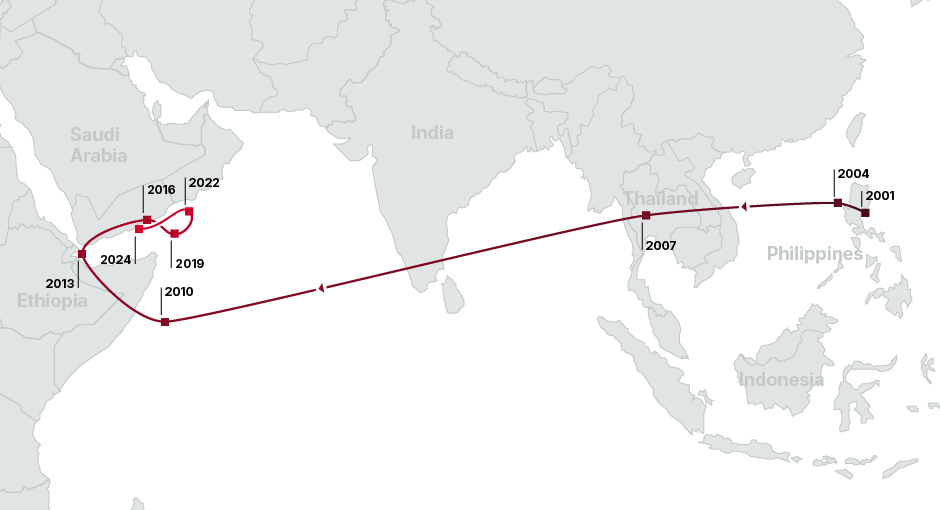
Based on its share of accounts, each country was given a weighting for every year it had a mobile money service. This weighting was then paired with the longitude and latitude of each country’s centre point. We then ran these three figures through a geographic information system calculator to determine a weighted midpoint for the countries with a service by year. All to check if Kenya is the epicentre of mobile money. Strictly speaking, it is not – Yemen is (Figure 1).
Figure 1: Mobile money’s changing centre of gravity, 2001 – 2024
Source: GSMA Mobile Money Deployment Tracker
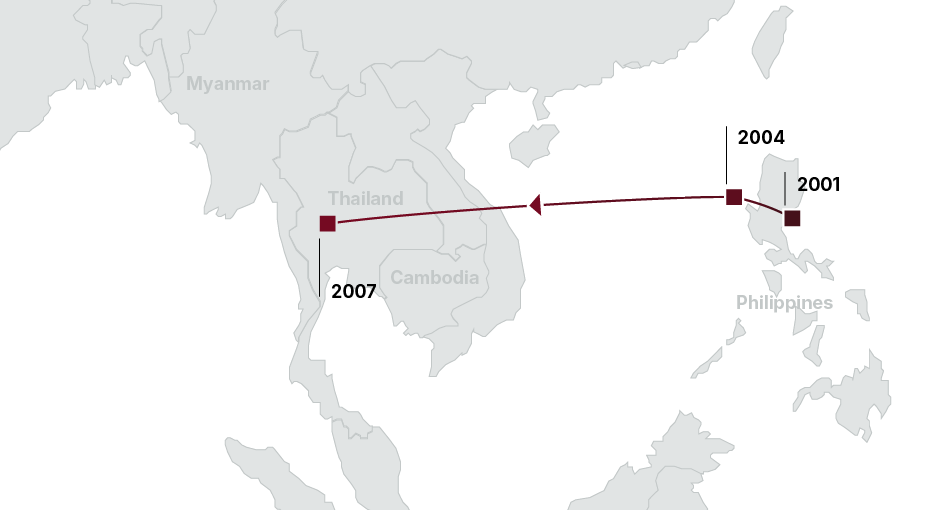
Between 2001 and 2004, mobile money’s centre of gravity was firmly east. Mobile money started in the Philippines in 2001, which is where the industry’s centre of gravity originates (Figure 2). By 2004, the Philippines was still the dominant global mobile money market. The centre of gravity had not shifted much, despite the launch of services in Russia, Thailand and Zambia between 2001 and 2004. Three years later, in 2007, the global mobile money landscape started to change. While M-Pesa was set up in 2007, it was the launch of services in Bangladesh, India and Indonesia that prompted the centre to shift to Thailand.
Figure 2: Mobile money’s centre of gravity, 2001 – 2007
Source: GSMA Mobile Money Deployment Tracker
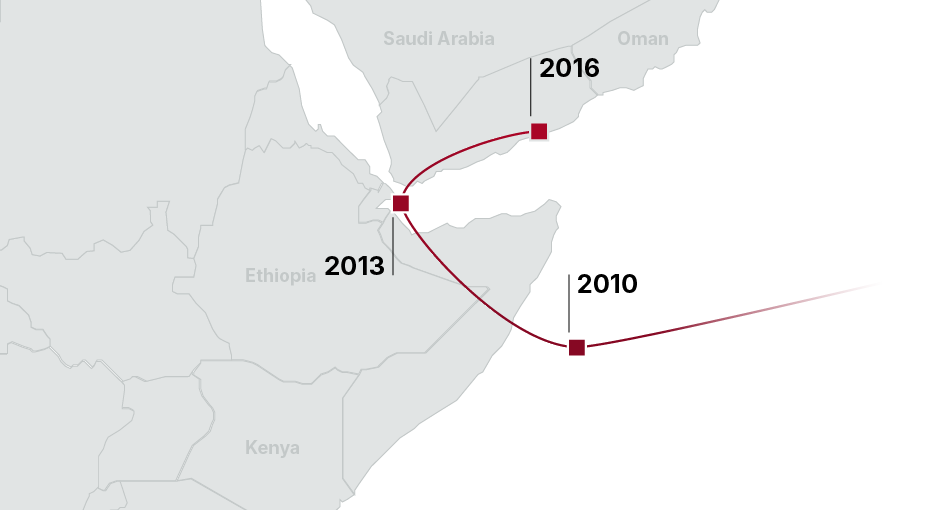
By 2010, the centre of gravity had shifted westwards towards Africa. As of 2010, Kenya had established itself as the dominant mobile money market worldwide. Mobile money services had also been launched in 30 new countries: 20 of these were in Africa. Importantly, six of these countries were in East Africa. Growth in registered accounts in these markets swung the centre of gravity westwards, towards Somalia.
At the end of 2013, mobile money was available in 79 countries. Kenya was no longer home to the highest number of registered accounts: the balance had shifted northwards, to Iran. Around 41 new countries had launched mobile money services by 2013. Africa accounted for 17 of these, while the rest were spread across Latin America and the Caribbean, the Middle East, Europe, and East Asia and the Pacific. Weighted pulls from these regions led to the centre of gravity shifting up, just off the coast of Djibouti (Figure 3).
Figure 3: Mobile money’s centre of gravity, 2010 – 2016
Source: GSMA Mobile Money Deployment Tracker
By 2016, after significant increases in adoption in various mobile money markets, the centre of gravity started to settle off the coast of Yemen. Services were launched in 13 new countries between 2013 and 2016, but only five of these were in Africa. New deployments in Central Asia, South Asia and East Asia led to a westward shift in the centre. Between 2013 and 2016, the dominant market shifted first from Iran to Tanzania in 2014, and subsequently to India in 2016.
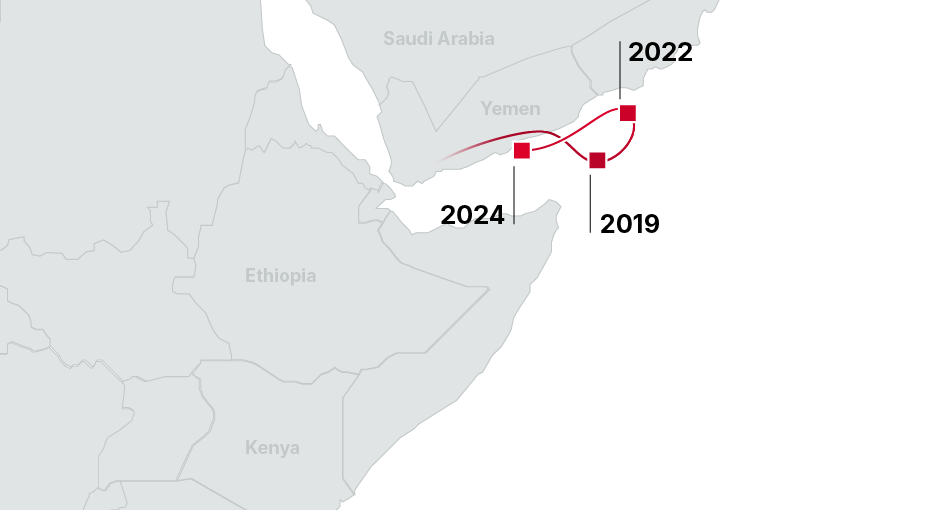
The end of 2019 marked the last time that several new countries launched mobile money services: deployments were launched in five new countries, three of which were in Africa. In total, at least 97 countries had a mobile money service at the end of the year. However, these new services did not lead to significant movement. Indonesia was now the dominant global mobile money market. Coupled with significant account growth in Asia, the centre shifted very slightly to the east.
Between 2019 and 2022, mobile money services were launched in three new markets: two of these were in the Caribbean. This meant that 100 countries now had mobile money services. By 2022, the COVID-19 pandemic had led to an increase in mobile money accounts in markets that already had a service. This growth was near-linear, which led to a slight shift: mobile money’s centre of gravity moved northeast, traversing the maritime border between Yemen and Oman (Figure 4).
Figure 4: Mobile money’s centre of gravity, 2019 – 2014
Source: GSMA Mobile Money Deployment Tracker
By 2024, it was clear that mobile money’s growth in Africa made the continent the most dominant region. Indonesia’s dominance was usurped by Nigeria in 2024, as part of a broader trend of faster growth in West African markets. Driven by this, mobile money’s centre of gravity shifted yet again. This time, westwards – off the coast of Yemen.
This position reflects the reality of mobile money. Out of 2.1 billion accounts worldwide, over 50% are in Sub-Saharan Africa. Asia, once the pioneer and with over 860 million registered accounts, remains an important counterweight. But the centre of gravity’s close proximity to Africa reflects the fact that mobile money is very much an African success story.
To learn more about the growth of mobile money or for more data on the industry, read the GSMA’s State of the Industry Report on Mobile Money 2025.