



One of the objectives of the 2011 Global Mobile Money Adoption Survey, which we announced earlier last week, was to compare the performance of different mobile money services with each other. In this post, we discuss the surprising results of this analysis.
As our primary measure of the performance of each deployment, we calculated the number of payments it processed each month. (We chose to measure the number of payments rather than customers so that we could accurately compare “wallet-based” services and “over-the-counter” services.) We divided the number of payments by the size of each operator’s mobile base, a proxy for its addressable market, allowing us to compare the performance of mobile operators with small market shares in small countries with those with large market shares in large markets. We plotted the evolution of this metric over time for each deployment in our sample, measuring time in months since each deployment had launched, allowing us to compare how quickly services have grown regardless of whether they launched recently or long ago.
We expected that the performance of mobile money services would follow a normal distribution: there would be a few fast-growing services, a few slow-growing services, and the majority somewhere in the middle. But in fact, as the chart below shows, we saw something completely different.
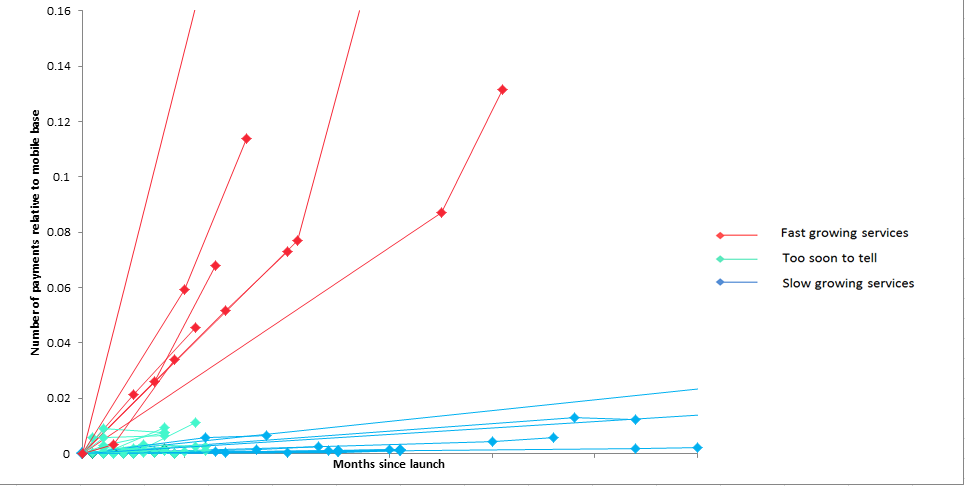
Eight services have, since they were launched, grown very fast—indeed, some are growing as fast as M-PESA did when it launched. Another group, despite having launched much earlier, has struggled to get traction with customers: the annualized growth rate of payment volumes for these 12 services was just 8% during the first half of 2011. The third and largest group is of services that launched after June 2010 and that have not yet grown rapidly.
What explains this divergence between fast- and slow-growing services? One possible explanation is network effects. Platform-mediated networks that are characterised by strong network effects tend either to grow explosively (sometimes called “tipping”) or to stagnate. Our data suggest that mobile money is not an exception to this pattern.
What is special about the eight-fast growing services? It’s a heterogeneous group: some of them emphasize bill payments, others p2p transfers. Some are wallet-based, while customers primarily transact over the counter with others. Some are offered by operators in a dominant position in the core business, others are not. Only in geographic distribution do we find some uniformity: six of the eight fast-growing services are in East Africa.
This segmentation has a profound implication for the providers of mobile money services in the “too soon to tell” category. Based on what we know about the mobile money business model, services with small customer bases are unlikely to be profitable. As such, if it is the case that mobile money services tend to grow explosively or not at all, then moderate success is not a coherent strategic goal: rapid adoption is the only path to sustainability. It is a daunting challenge, but eight pacesetters prove it can be done.