


MWC26 | Open Gateway Summit | Accelerating Network API Adoption | Session 3
Vertical industries aren’t waiting for perfect conditions. They’re deploying now, and the results are measurable.
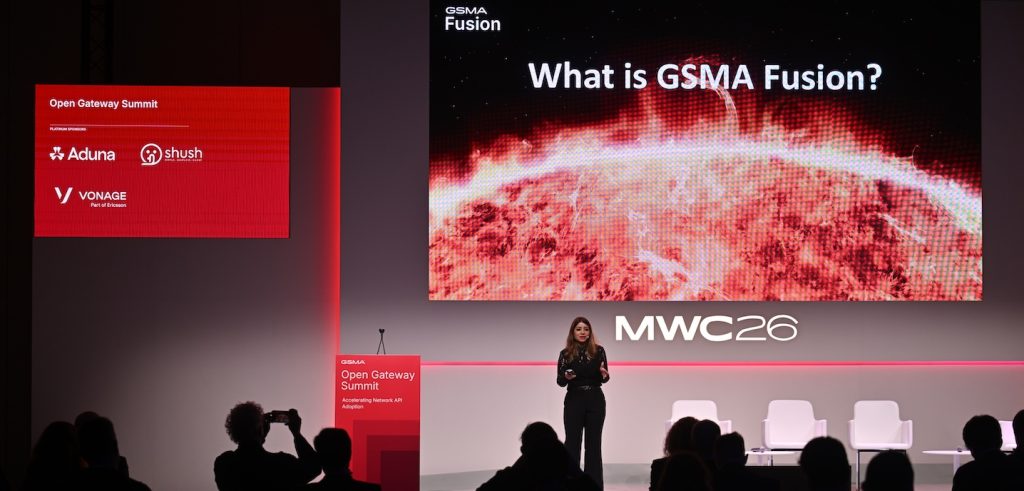
The final session of the GSMA Open Gateway Summit arrived with a deliberate change of register. Chaired by Natasha Nayak (Technology Director, GSMA Fusion), Session 3, Dial M for Monetise: How vertical industries are using network APIs to solve real-world problems, moved away from architectural frameworks and commercialisation and toward something more grounding: proof.
Across automotive, aviation, and live broadcast, network APIs are not being piloted in sandboxes. They are live, they are processing real transactions, and they are generating measurable outcomes. The challenge now is removing the barriers that prevent this from scaling.
GSMA Fusion: Starting from Enterprise Pain, Not the API Catalogue
Natasha Nayak opened with a statement of methodology that set the tone for the session: GSMA Project Fusion doesn’t start with the API catalogue and work outward. It starts with enterprise pain points, translates them into requirements, and mobilises operators to align supply behind real demand.
The results speak for themselves:
- A FinTech in Portugal using fraud and authentication APIs to reduce onboarding drop-off
- Brazil processing 500,000 SIM swap and number verify transactions per month
- Asia Pacific trading platforms reporting a 58% improvement in onboarding success by replacing SMS OTP with number verify
Fusion works with 200+ enterprises daily. The message is consistent: when network APIs are positioned as operational necessities, not optional enhancements, enterprise adoption follows.
The Three Conditions for Real-World Impact
Anthony Bartolo (Aduna) delivered one of the session’s most quotable frameworks. Enterprise teams are not short of APIs. They are short of time and tolerance for integration complexity. Network APIs only get prioritised if they drop into an existing workflow and move a metric the business already cares about.
“Network programmability is the middle of the story, not the end. The ends are raw network signals on one side, and business outcomes on the other.”
Anthony Bartolo, Aduna
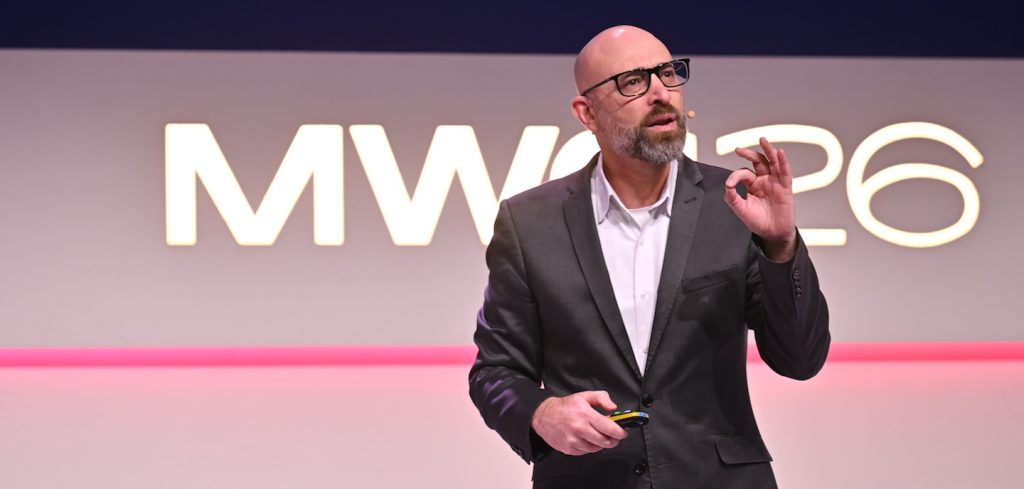
Bartolo’s three conditions for real-world impact at scale:
- Simplified access: one integration reaching many networks with standard, predictable semantics
- Consistency of behaviour and security across all networks: this is the product feature, not just the infrastructure
- Commercial viability: clear pricing models tied to outcomes (e.g. per transaction, per session), not just per API call
He illustrated this with two examples: a fintech using network-based identity verification to reduce OTP friction and lower fraud rates; and a logistics operator using network proximity APIs to improve last-mile delivery accuracy in indoor environments where GPS fails.
Automotive: From ‘Best Effort’ to Guaranteed
The automotive panel featuring Chetan Narang (COLT), Sridhar Gollapudi (Google), RajaGopalan Rajappa (TATA Elxsi), and Roger Berg (Denso) opened a window into an industry that is quietly moving from frustration to possibility.
Roger Berg put the aspiration plainly: if automotive safety systems – for example, brakes, turn signals – are 100% reliable by design, there is no engineering reason why connected vehicle services should be any less so. But for years, ‘best effort’ connectivity made that impossible.
COLT and Google are now combining agentic AI with CAMARA QoD APIs to create something genuinely new: a closed-loop, self-healing network for automotive applications. AI agents observe network and application signals in real time, detect performance deviations, and automatically invoke QoD APIs to correct them, without human intervention.
Aduna has unified wireless and wireline environments so that developers no longer need to differentiate between WiFi and mobile. The abstraction layer handles it, with 100+ providers already adopted. For connected vehicle deployments spanning multiple network environments, this is a significant commercial unlock.
Broadcast: A 5G Network at 350 Metres
Sam Yoffe (Neutral Wireless) brought the session’s most vivid example of network APIs solving a genuinely hard problem in the field. Bonded-cellular technology has largely replaced satellite for live broadcast. But in congested environments like major sporting events, public networks cannot sustain the bitrates broadcast requires.
The proof-of-concept: a full private 5G network deployed on an ultralight aircraft, operating at 350 metres altitude, providing connectivity for live TV cameras during a cycling race in Brittany for France TV. CO2 production was approximately 98% lower than traditional helicopter-relay systems.
“Without QoD, congestion reduced both streams to around 6Mbps, insufficient for broadcast quality. With a QoD priority session created, the broadcast stream was protected and video quality restored immediately.”
Sam Yoffe, Neutral Wireless
The demonstration was a clear proof of the CAMARA QoD value proposition: guaranteed performance when it matters, not just best-effort availability. Neutral Wireless is actively seeking partners for airborne 5G and network API deployments in broadcast and PPDR (Public Protection and Disaster Relief) through 2026.
The Closing Panel: Technology is Ready. What Isn’t?
The final panel, moderated by Rob Kurver (CPaaS Acceleration Alliance), was refreshingly honest about what the industry still needs to solve. The panellists’ closing insight: the technology is largely ready. Regulation, commercial model design, and ecosystem building are the remaining barriers.
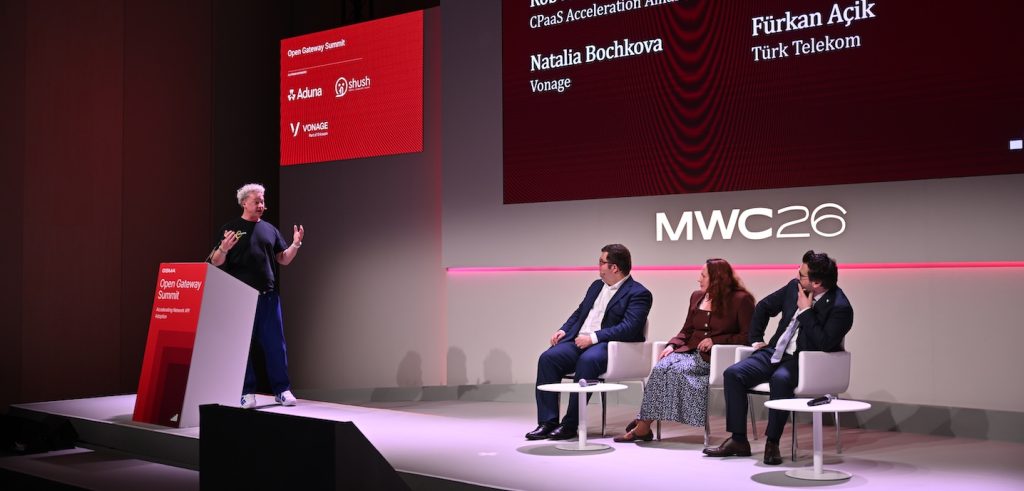
The aviation use case, presented by Ignacio Tobias (Air Europa) and Furkan Açık (Türk Telekom), illustrated a problem that is both mundane and urgent. When an aircraft is at the gate, operational devices, used for pre-departure checks, safety communications, and crew coordination, compete for the same congested airport network as hundreds of passenger smartphones streaming video.
The result: safety-critical and operational data suffers latency and unreliability at exactly the moments it matters most. QoD APIs that can prioritise this traffic are not an engineering experiment. They are an operational necessity.
Türk Telekom added a complementary dimension with drone-based use cases: high-altitude surveillance running 40+ hours of HD footage, emergency landing guidance, and remote infrastructure inspection. Three UAV base stations are planned for deployment in the next quarter.
The panel was candid about the pace of change: aviation is highly regulated, and every digital transformation must be validated as thoroughly as the analogue systems it replaces. Patience and ecosystem co-design matter here, not just technical capability.
One observation stood out: fraud and authentication use cases are well understood because they plug into existing workflows. QoD and performance APIs require creating entirely new enterprise workflows; there is no existing process to integrate into. This is a go-to-market challenge, not a technical one, and it requires education, demand generation, and vertical expertise that the current ecosystem is too small to provide.
The call to action was clear: the industry needs more startups, accelerator programmes, and university partnerships bridging the gap between network API capability and the specific operational realities of each vertical.
Key Takeaways from Session 3
- Measurable outcomes are already here: fraud reduction, onboarding improvement, and delivery accuracy are proven at scale
- Vertical industries have urgent, concrete needs, but they require patient ecosystem co-design, not just API access
- Simplified access, consistent cross-network behaviour, and outcome-based pricing models are the three conditions that must all be true for mainstream enterprise adoption
- QoD and performance APIs require creating new enterprise workflows. This is a go-to-market and education challenge, not a technical one
- The ecosystem needs more startups, accelerators, and university programmes bridging network capability and vertical industry deployment
GSMA Open Gateway Summit · MWC Barcelona 2026
Three sessions. One direction of travel: from capability to commercial outcomes.