


eSIM Compliance
The GSMA eSIM Compliance Process provides a common framework for demonstrating that eSIM products meet the applicable GSMA Remote SIM Provisioning requirements for security, functionality and interoperability.
The process applies to the different elements of the eSIM ecosystem, including eUICCs, Subscription Management servers, eIMs and Consumer and IoT Devices.
The certification journeys below provide a simple overview of the requirements and steps applicable to each type of product.
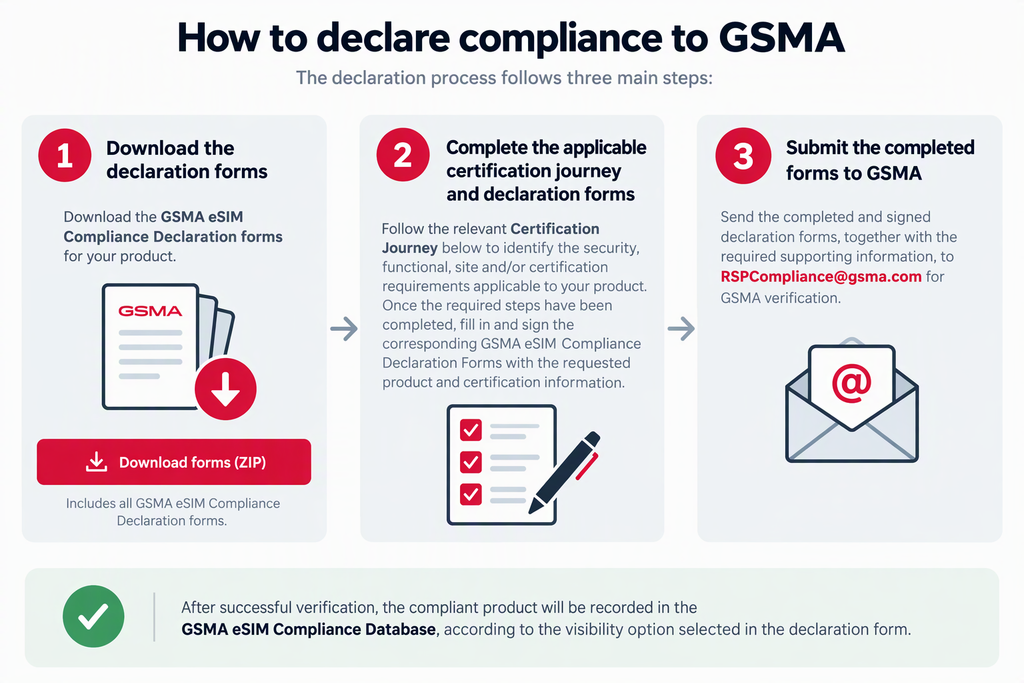
Download the GSMA eSIM Compliance Declaration forms here and when ready, send it to RSPCompliance@gsma.com
RSP Architecture Elements Certification Journey
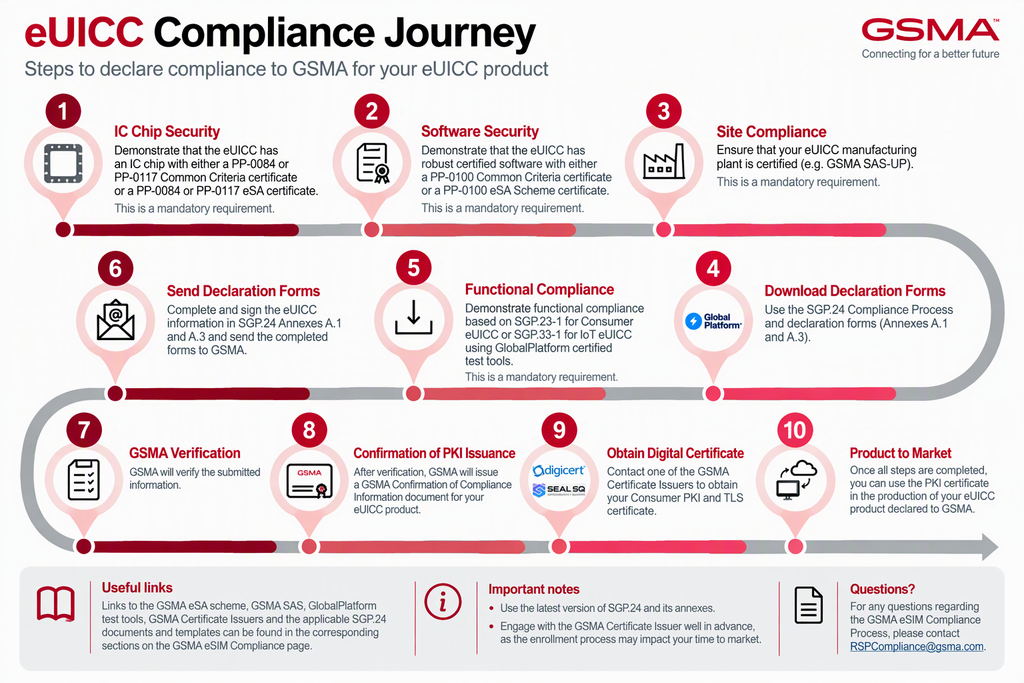
eUICC Compliance Process
Useful links and further information
For the steps shown in the eUICC Compliance Journey, I suggest placing this directly below the image:
- Steps 1–2 – IC Chip and Software Security: The eUICC must meet the applicable security certification requirements through Common Criteria or the GSMA eUICC Security Assurance (eSA) Scheme. Information about the GSMA eSA Scheme is available online.
- Step 3 – Site Compliance: The eUICC production site must meet the applicable GSMA security requirements. Information about GSMA SAS-UP is available on the GSMA Security Accreditation Scheme webpage. For SAS-related questions, contact SAS@gsma.com.
- Steps 4–7 – Functional Compliance and GSMA Declaration: Functional compliance is based on SGP.23-1 for Consumer eUICCs and SGP.33-1 for IoT eUICCs. Testing is performed using appropriate GlobalPlatform-certified test tools. Information about available test suites can be found on the GlobalPlatform Test Suites webpage. Complete the applicable GSMA eSIM Compliance Forms Annex A.1 and A.3 declaration forms and submit them to RSPCompliance@gsma.com.
- Steps 8–9 – Confirmation and Digital Certificates: Following successful GSMA verification, GSMA issues the applicable Confirmation of Compliance Information. Contact one of the GSMA Certificate Issuers to complete enrolment and obtain the required PKI certificates. Information on the available Certificate Issuers can be found on the GSMA Certificate Issuers page.
- Download the GSMA eSIM Declaration Forms: Download the applicable GSMA eSIM Declaration Forms for your product using the links provided at the beginning of this page.
- Questions and submission: Completed declaration forms and questions regarding the GSMA eSIM Compliance Process should be sent to RSPCompliance@gsma.com.
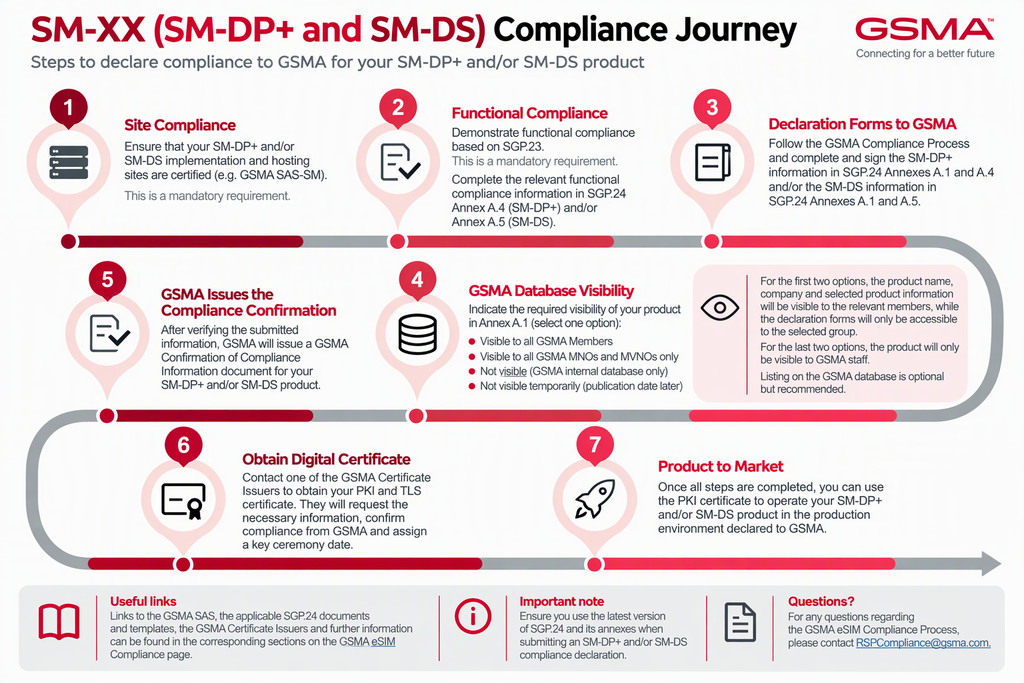
SM-XX Compliance Process
Useful links and further information
- Step 1 – Site Compliance: The SM-DP+ and/or SM-DS implementation and hosting sites must be certified following the GSMA SAS-SM standards, methodology and process. This is a mandatory requirement. Further information is available on the GSMA SAS webpage, or contact SAS@gsma.com.
- Step 2 – Functional Compliance: Demonstrate functional compliance based on SGP.23. This is mandatory and can be performed using self-testing methods or available test tools. GSMA eSIM Declaration form in Annex A.4 for SM-DP+ and/or Annex A.5 for SM-DS.
- Steps 3–5 – Declaration and GSMA Compliance: Follow the applicable GSMA eSIM Compliance Process. For SM-DP+, complete Annexes A.1 and A.4; for SM-DS, complete Annexes A.1 and A.5. Submit the completed forms to RSPCompliance@gsma.com. After verification, GSMA will issue the GSMA Confirmation of Compliance Information.
- Step 6 – Digital Certificate: Once GSMA compliance has been confirmed, contact one of the GSMA Certificate Issuers to obtain the required Consumer PKI and TLS certificates. The Certificate Issuer will complete its enrolment process, confirm compliance with GSMA and arrange the certificate issuance/key ceremony.
- Step 7 – Product to Market: Once the applicable steps have been completed, the PKI and TLS certificates can be used for the SM-DP+ and/or SM-DS services operated from the accredited SAS-SM sites.
- Download the GSMA eSIM Declaration Forms: Download the applicable GSMA eSIM Declaration Forms for your product using the links provided at the beginning of this page.
- Questions and submissions: Completed declaration forms and questions about the GSMA eSIM Compliance Process should be sent to RSPCompliance@gsma.com
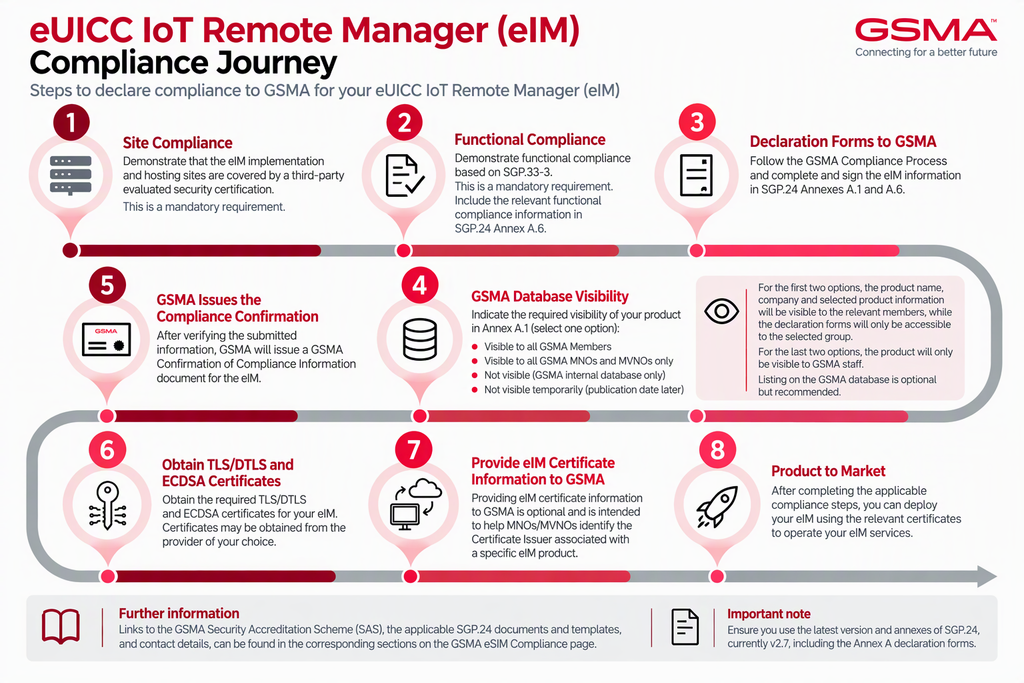
eIM Compliance Process
Useful links and further information
For the steps shown in the eUICC IoT Remote Manager (eIM) Compliance Journey, please use the following resources:
- Step 1 – Site Compliance: The eIM implementation and hosting sites must have third-party evaluated security certification. GSMA SAS-SM is one available option. For information about the GSMA Security Accreditation Scheme, visit the GSMA SAS webpage or contact SAS@gsma.com.
- Step 2 – Functional Compliance: Functional compliance is based on SGP.33-3 and may be demonstrated using self-testing or available test tools. The relevant information must be included in GSMA eSIM Compliance Form Annex A.6.
- Steps 3–5 – GSMA Compliance Process: Download the applicable GSMA eSIM Compliance Declarations and complete the applicable Annex A.1 and Annex A.6 declaration forms.
- Steps 6–7 – eIM Certificates: Obtain the required TLS/DTLS and ECDSA certificates from the certificate provider of your choice. Providing the corresponding eIM certificate information to GSMA is optional and helps MNOs and MVNOs identify the Certificate Issuer associated with an eIM product.
- Download the GSMA eSIM Declaration Forms: Download the applicable GSMA eSIM Declaration Forms for your product using the links provided at the beginning of this page.
- Questions and submissions: Completed declaration forms and questions about the GSMA eSIM Compliance Process should be sent to RSPCompliance@gsma.com
Consumer Device (LPAd) Compliance Process
Useful links and further information
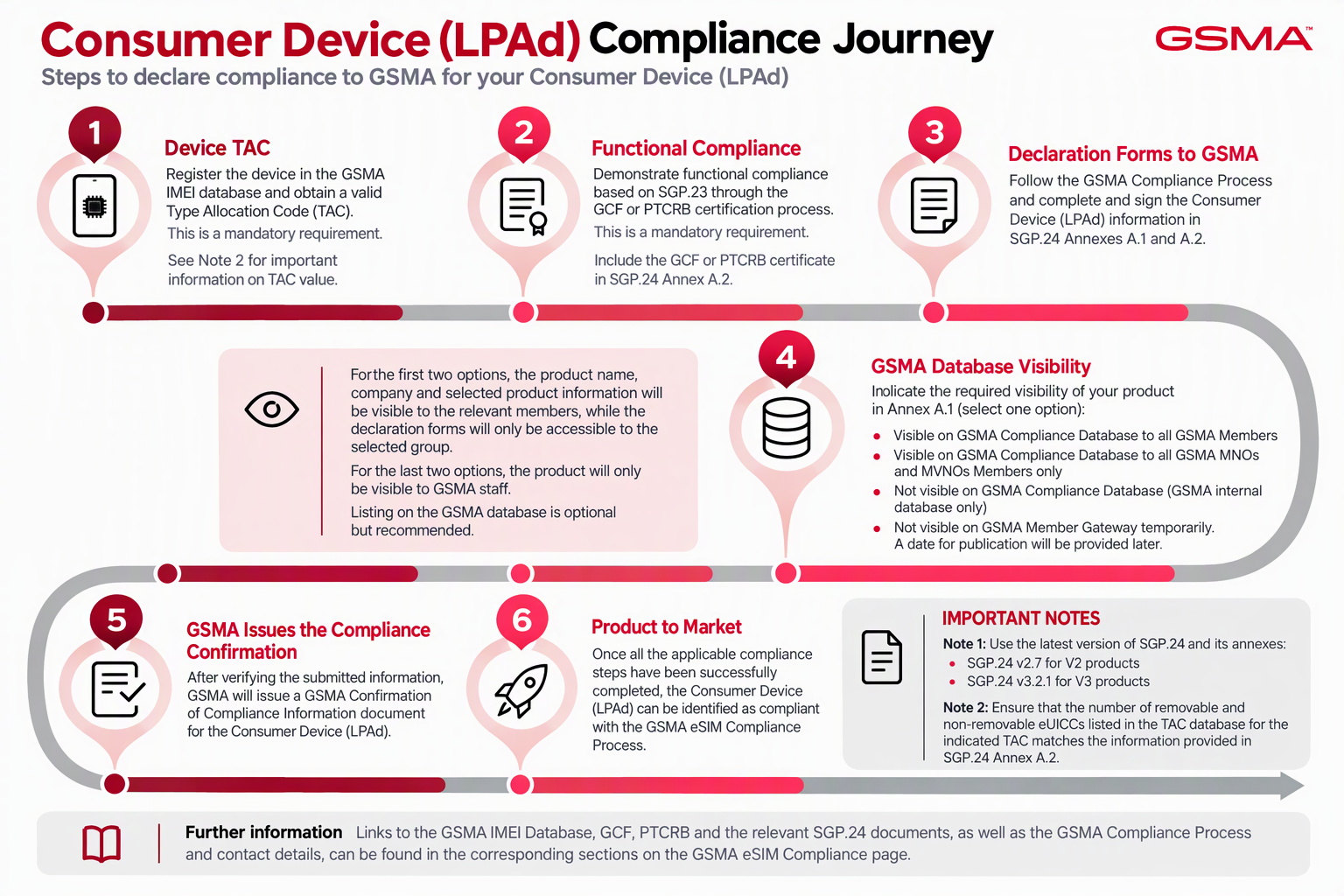
For the steps shown in the Consumer Device (LPAd) Compliance Journey, please use the following resources:
- Step 1 – Device TAC: Access the GSMA IMEI Database for information on device registration and TAC allocation.
- Step 2 – Functional Compliance: Further information on device certification is available from GCF and PTCRB.
- Steps 3–5 – GSMA Compliance Process: Follow the applicable GSMA eSIM Compliance Process and complete Annex A.1 and Annex A.2 declaration forms for the Consumer Device (LPAd).
- Download the GSMA eSIM Declaration Forms: Download the applicable GSMA eSIM Declaration Forms for your product using the links provided at the beginning of this page.
- Questions and submissions: Completed declaration forms and questions about the GSMA eSIM Compliance Process should be sent to RSPCompliance@gsma.com
IoT Device (IPAd) Compliance Process
Useful links and further information
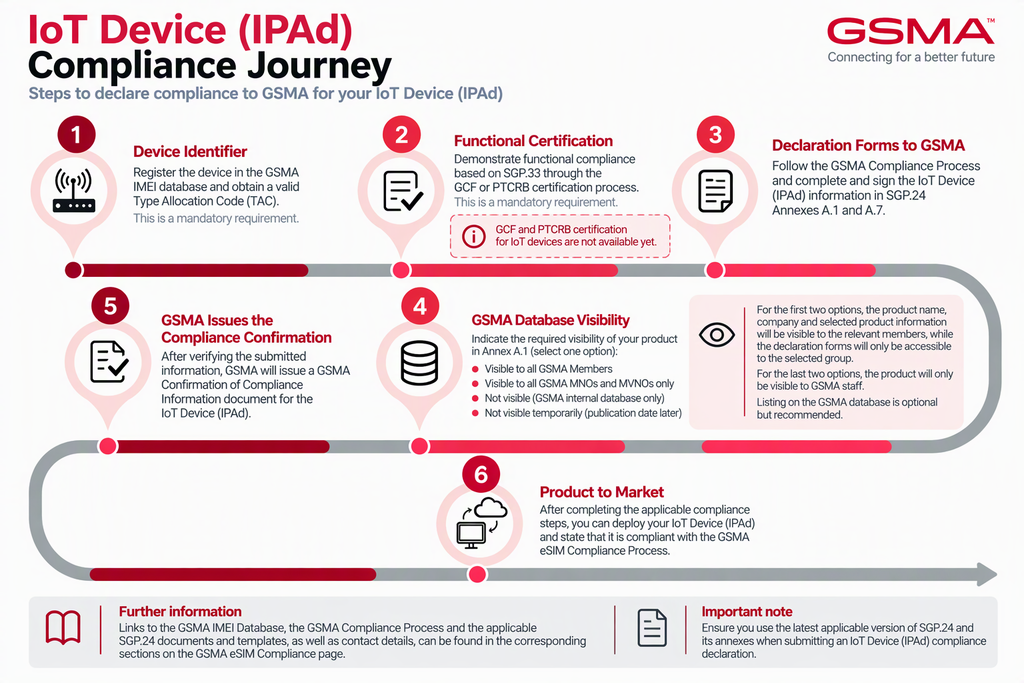
For the steps shown in the IoT Device (IPAd) Compliance Journey, the text below the image could read:
- Step 1 – Device Identifier: Access the GSMA IMEI Database for device registration and TAC allocation.
- Step 2 – Functional Certification: Functional compliance for the IoT Device (IPAd) is based on SGP.33. GCF and PTCRB certification for IoT Devices is not yet available. The applicable functional certification route should therefore be checked against the latest GSMA compliance requirements.
- Steps 3–5 – GSMA Compliance Process: Follow the applicable GSMA eSIM Compliance Process and complete the Annex A.1 and Annex A.7 declaration forms for the IoT Device (IPAd).
- Download the GSMA eSIM Declaration Forms: Download the applicable GSMA eSIM Declaration Forms for your product using the links provided at the beginning of this page.
- Questions and submissions: Completed declaration forms and questions about the GSMA eSIM Compliance Process should be sent to RSPCompliance@gsma.com
Find out more
Check here all the eSIM Consumer Specifications referred in this section.
For further information on the GSMA eSIM compliance process, please contact RSPCompliance@gsma.com