Friday 8 May, 2026
MWC25 Summit explored how to improve the business case for cell towers and fibre links
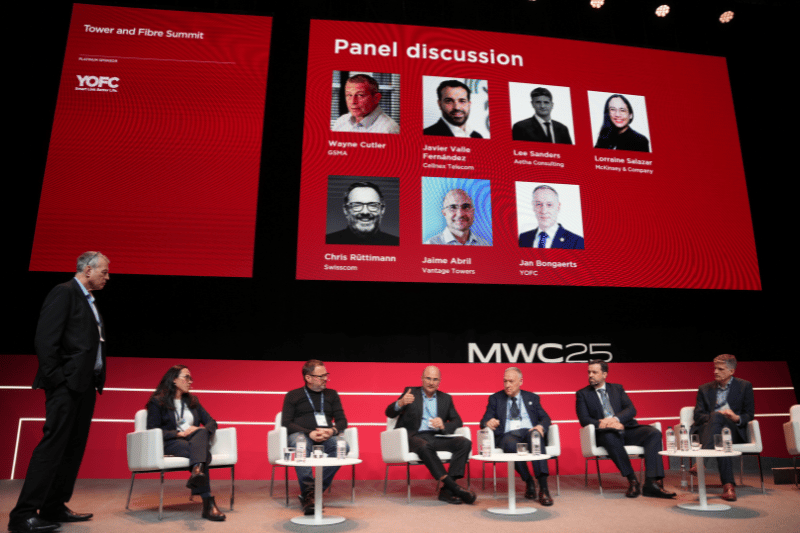
As they weigh up how to enhance the coverage and capacity of their networks, mobile operators and their partners face some formidable financial and logistical obstacles. Hosted by the GSMA at MWC25, the Tower & Fibre Summit debated how best to overcome these barriers to address the rising demand for more connectivity to support widespread adoption of artificial intelligence (AI) and other advanced services.
One priority is to lower energy and maintenance costs. Chris Rüttimann, Head of Cell Tower Infrastructure at Swisscom, explained that with the right data insights, operators can make very big savings on cooling costs, in particular. By analysing data collected by its Infravista system, Swisscom has reduced the energy it requires for air conditioning by 90%, for example, helping to lower its annual energy bill by €3.7 million. “That’s just the beginning – we are just starting,” he added.
Swisscom had more than 300 types of cooling equipment when Chris Rüttimann joined the business. He has since reduced that to four, while also extending the timeline for site maintenance from one year to two years. “You can get 20-25% [additional energy] from putting solar on your cell towers, so that should be the goal in the future for our industry,” he added.
At the same time, fibre technology is getting better and more efficient. Jan Bongaerts, Senior Vice President of YOFC, described hollow core fibre “as the most exciting development at this moment in our company”. As the traffic travels through air, rather than through glass, YOFC says latency is reduced by 31%.
Driving densification through small cells
Even so, relatively high interest rates mean investments in new infrastructure have to be very carefully calibrated, noted Javier Valle Fernández, Global Customer & Product Development Director at Cellnex Telecom. While a push for network densification is driving growing demand for small cells, he stressed the need for a low-cost deployment model. Cellnex, which is technology agnostic, offers small cells-as-a-service to mobile operators.
Vantage Towers, which manages 86,000 macro sites, has piloted the deployment of small cells embedded in shop signs to provide coverage across several hundred metres. But Jaime Abril, Head of Business and Product Development of Vantage Towers, noted such an approach is difficult to scale because you have to negotiate site-by-site. Instead, Vantage would like to secure access to publicly owned street furniture with minimal administrative fees. “We hope the [EU] Gigabit Infrastructure Act will help,” Jaime Abril said. “We will see how this is executed across the different European markets, especially at municipal level.” While cautioning the rollout will take time, he predicted that small cells “will be massive.”
He also praised a model developed by the UK, which employs a neutral host to provide in-building coverage on behalf of all operators. “This is a move we are very excited about and we hope it will gradually be adopted in continental Europe,” he added.
Vantage Towers offers its customers “power-as-a-service”, employing renewable energy and efficiency measures to lower costs and greenhouse gas emissions as much as possible. Javier Valle Fernández highlighted opportunities to generate new revenues by, for example, co-locating batteries with cell towers to help balance the electricity grid. Speakers also flagged growing demand to mount sensors and electric vehicle charging points on towers, as well as the potential to use base stations to provide far edge computing capacity.
Seeking economies of scale
Even with these opportunities, the mobile infrastructure market is seeing multiple rounds of consolidation and delayering, as players look to build economies of scale, noted Lee Sanders, Managing Partner at Aetha Consulting. “Is Spain the future?” he asked, where there could be consolidation to just two radio access networks. He said that one project by Aetha Consulting found that RAN sharing could reduce the number of sites required by 30% (lowering operating costs).
For mobile network operators, financial pressures mean “moving from macro sites to small cells is, to an extent, a last resort,” Lee Sanders added. “And if you look at the supply side factors, you have got more spectrum coming online, antenna technology is moving fast…huge capacity increases.” These factors could be enough to accommodate the current traffic growth of 14% a year, he suggested, but AI might “drive data traffic growth and change the profile of it” by making it more symmetric.”
Indeed, massive investment – in the region of US$ 400 billion – is still required, cautioned Lorraine Carlos Salazar, Senior Knowledge Expert at McKinsey & Company. Although there was an upturn in capex in 2024, “much of that growth is not really coming into towers and fibres, but going into data centres,” she added.
By the end of 2024, there were 5.1 million towers deployed globally, up only modestly from 5 million in 2023, Lorraine Carlos Salazar noted. Many operators are now moving into network sharing in Asia, as well as Europe, as the network is no longer seen as a source of distinctiveness, she added, recommending that tower companies look beyond their core business for growth. “There is a big play here for tower cos to think about using their assets … to build the next generation infrastructure for AI,” she suggested. In the next 3-5 years, by McKinsey’s count, there are plans to build 2,500 to 2,600 new data centres, driving further demand for fibre.