Thursday 26 November, 2026
%
of around 4,500 towers digitised
%
faster co-location: from 30 days to 7, from operator request to order confirmation
%
shorter handover for towers acquired through sale-and-leaseback
pre-solution site visits for a standard co-location request eliminated

Challenge
Most tower digital twins are captured once and then slowly drift out of date with predictable results for performance. A telecom tower changes more often than its paperwork suggests. Antennas are added for a new tenant, radios are swapped in a network upgrade, a mount is reinforced. Each change appears small but add up over a few years to an entirely different structure that no longer matches the file.
That gap creates expenses for the towers owner and MNO tenants. Every co-location request, upgrade and structural check starts with the same question: what is actually on this tower today? For most of the industry’s history, the only reliable answer has been to send someone to look.

Solution
PhilTower took a different route by creating living twins for 98% of its portfolio of around 4,500 towers. By keeping each model current as the towers change, co-location, engineering and maintenance decisions can be made from that record. MNOs get feasibility answers in days, not weeks, with far fewer trips to the tower.
With digital twin platform SiteSee, field capture partner QNSI and engineering partner GSM Telecom Products AS, it has built a record of its portfolio that is used every day with confidence.
“The future advantage for infrastructure operators will not come from owning more assets, but from understanding and activating the intelligence hidden within the assets they already own.
Devid Gubiani, CEO & President, PhilTower-MIDC
Why constantly digitise: the map is not the territory
When PhilTower acquired towers from Globe Telecom in the north and south of the country, the sites changed hands on an “as-is, where-is” basis. The master database was the only record of what each tower carried. PhilTower needed an accurate, comparable way to count every asset quickly to protect the value it had bought and also to find capacity it could sell.
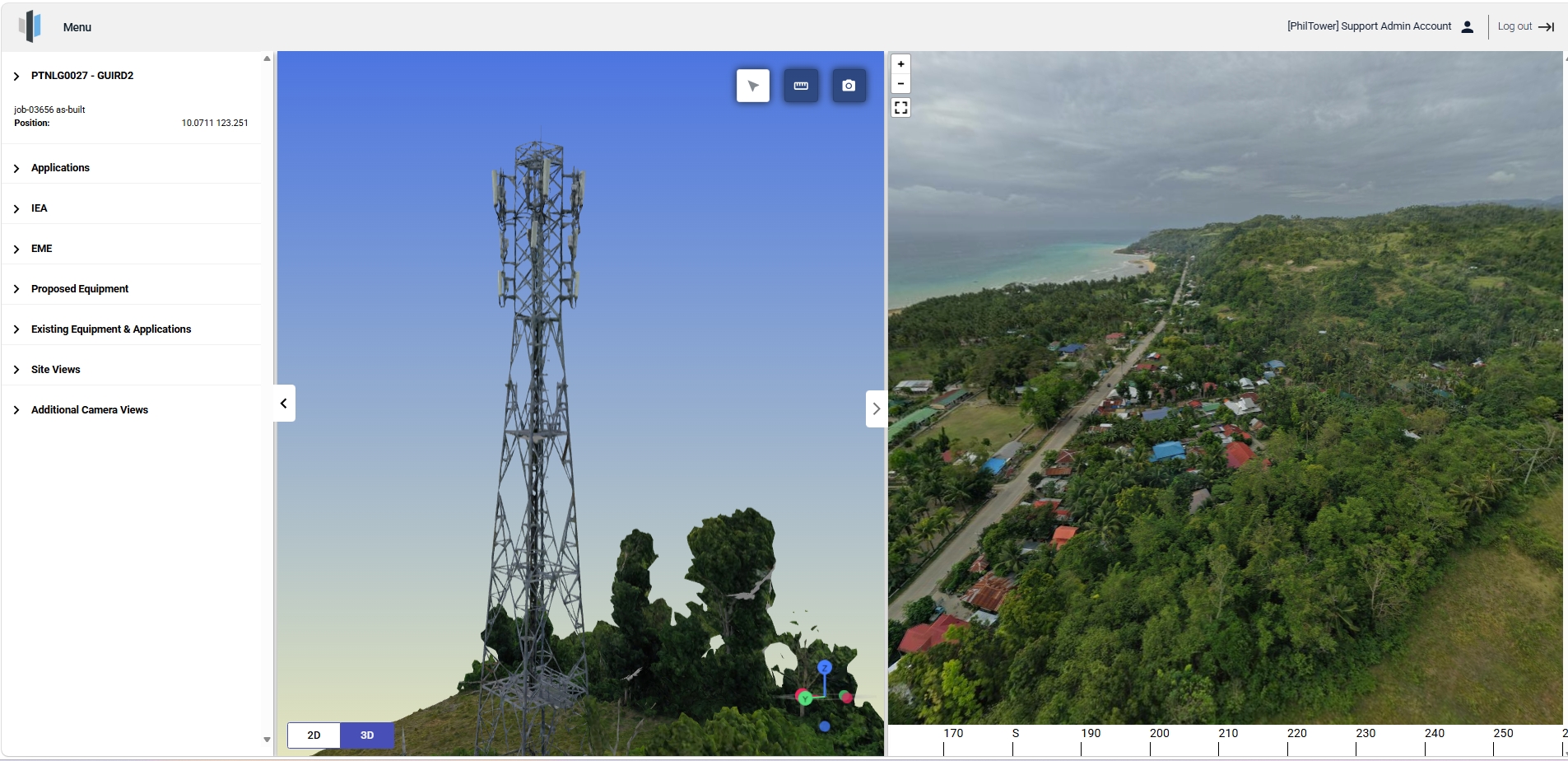
Even a few years ago, digital twin technology was not ready for that depth of use, but that has since changed. In 2023 PhilTower took the steps necessary to create drone-captured twin a standard part of its handover audit for sale-and-leaseback (SLB) sites. Each tower became a measurable 3D model, with high-resolution imagery, a verified equipment inventory and 360° views of the surroundings. The programme then extended across the portfolio. Today 98% of PhilTower’s towers have a twin, giving one consistent view of the business instead of a patchwork of acquired records.
Capture, however, is only the starting point. Through SiteSee’s NexDT module, engineers add or remove antennas and ancillary equipment on the model as each co-location and upgrade project is completed. Twins are also refreshed on a regular cycle to catch configuration changes, and full re-captures follow major network changes: all sites in the Visayas and Mindanao will be re-flown in 2027 after activity on sites warrants it.
PhilTower then linked the models to Infra-AI, its AI-driven engineering intelligence platform, which holds each tower’s design capacity, loading records and engineering documentation. The twin shows what is on the tower; Infra-AI explains what that means for the structure.
“It’s a recurring process. It’s not a one-off where you do it in year one and five years from now it’s still reliable. It has to be constantly maintained and constantly curated. A digital twin does not replace engineering. It strengthens engineering. Decisions are based on verified visual data, not assumptions.
Shariful Islam, Director of Engineering, PhilTower
Workflow integration: the record runs the business
The first payoff came in the handover itself. For SLB acquisitions, PhilTower halved the time to complete a site handover. Drone capture ran roughly three times faster than manual climbing audits at 10% lower cost per site, and it found equipment that was installed but missing from the master database. That equipment is now factored into monthly rental charges, adding loading revenue and enterprise value on a per-site basis.
Labour in the Philippines is relatively inexpensive, and PhilTower found that a manual survey and a drone capture cost about the same per site. The difference is reuse. A survey report serves one request; a twin serves every request that follows, and it can be opened at once to engineers at headquarters and to customers.
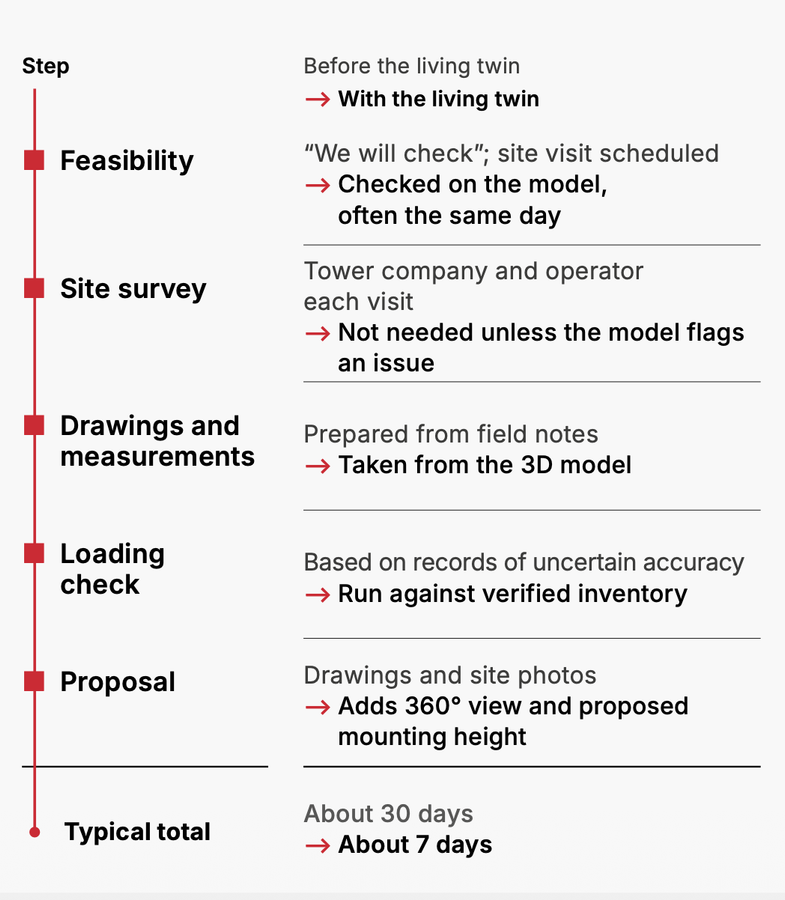
Before the twin, every co-location request, expansion and tower health check triggered its own manual audit. Today one record serves them all. The techno- commercial and solutioning team uses it to find towers with spare capacity and offer them to operators proactively. Engineering uses it to maintain digital loading records and to produce technical proposals and design drawings from verified geometry. A standard co-location used to need two site visits, one by the tower company and one by the operator. In standard cases those van rolls are now not needed.
The twin also brings discipline to network programmes. For example, in equipment swap projects, the twins allow PhilTower to reconcile towers before and after work. By comparing the solution in the operator’s technical site survey to what was installed PhilTower can ensure sites are kept safe. Quantity and effective projected area are what drives wind load, a critical safety factor everywhere, but especially so in the Philippines.
“With drone-built digital twins, we see the tower, its available space and its surroundings before anyone travels. This enables us to choose the right co-location quickly and plan our rollout with confidence.
Debbie M. Hu, FVP for Network Build and Implementation, Smart
Delivery speed: faster answers, better engineering
In a competitive market, co-location speed decides who wins the tenancy. Operators deploy in set windows, and a slow answer sends the business to a rival. PhilTower’s time from request to order confirmation has fallen by 75–80%, from about a month to about a week.
Upgrades follow the same pattern. The twin gives an accurate equipment baseline, so PhilTower can tell an operator early whether a tower can take more capacity, instead of agreeing first and walking it back later. Every change is tracked, its structural effect assessed instantly in Infra-AI and the added load billed correctly.
The model also changes how PhilTower looks after its assets. Automated inspection flags missing bolts and heavy corrosion so maintenance can be planned before a defect becomes a failure. In a country exposed to typhoons and earthquakes, Infra-AI combines each tower’s design capacity, actual loading and disaster history to rank sites by risk, guiding strengthening work, post-event inspections and insurance cover tailored to each location.
“A Digital Twin coupled with Drone Technology can create an accurate 3D digital reproduction of towers, mounted equipment and antenna, and other surrounding ground-based structures. For Telcos, the direct benefits are minimizing hazardous tower climbs, asset inventory tracking including EPA utilization, and faster technology and coverage planning (e.g. 5G deployment).
Erwin Roque, AVP – Network Engineering and Asset Management, Globe Telecom
Build on the foundation
— PhilTower sees the twin as the foundation of a wider programme to digitalise, automate, optimise and reuse.
— Automated workflows for maintenance, lease management, utility, and site access already save more than 2,000 working hours a month.
— Infra-AI turns twin data into engineering decisions, and PowerX, finds underused power equipment to redeploy before new capital is spent.
— Linking maintenance programmes to the twin, disaster and hazard historical data for revenue assurance and structural safety is our next mission.

Find a trigger, and start working
— Its advice to other tower companies is simple: start at a natural trigger such as an acquisition, design the update process and not just the capture, and put the record at the centre of daily decisions.
— The results achieved include improved capex efficiency, faster colocation turnaround times, fewer field truck rolls, reduced time to restore, and greater asset register accuracy.

Improve the MNO-towerco relationship
— Both of PhilTower’s main customers use the platform directly, for different reasons.
— Globe uses it to see how much more equipment can be loaded, useful for 5G planning.
— Smart uses it to identify the best locations to co-locate.
— Operator radio planning and transmission teams also check line of sight and obstacles for new links from their desks, using the twin’s panoramic viewsa

Reduce disputes and friction
— The shared record has increased the trust of the relationship as much as its speed. Once a tower has a twin, there is little room to dispute what is on it, which has made commercial discussions faster and more collaborative.
— Fewer site visits cut cost and safety exposure on both sides, and operators can plan rollouts with more confidence.

Key partners
If you like this report, you can download the pdf version, below: