



The mobile industry is entering an important phase of development as 5G expands and the capacity for next-generation networks in the 2030s is developed by government and industry. Policy and regulatory decisions taken over the next few years will influence whether mobile networks can evolve efficiently from 5G and 5G-Advanced towards 6G. Spectrum – including the upper 6 GHz band (6.425-7.125 GHz) – is a crucial ingredient.
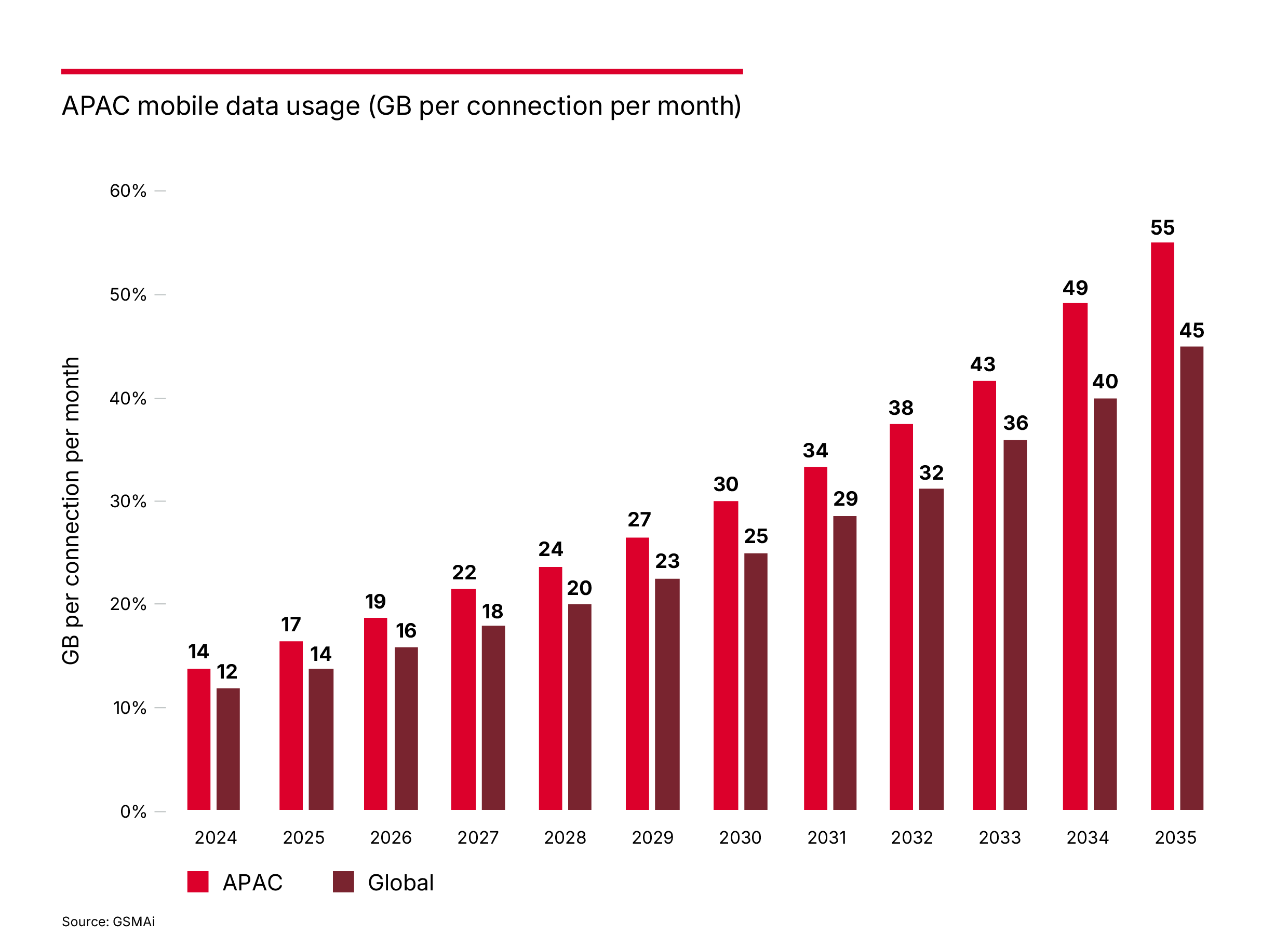
Research by GSMA Intelligence has shown the economic value of delivering a clear spectrum pipeline in 10 cities in the Asia Pacific region. APAC is home to some of the world’s most advanced and fast-growing economies. Data traffic in APAC is already higher than global averages in the region and the gap is set to widen. Average monthly data per connection in APAC was 17 GB in 2025 and is expected to treble to 55 GB by 2035.
2 GHz of mid-band spectrum will be required by around 2030 – demand which can be supported by 6 GHz capacity. Cities with over 50% of the world’s urban population will be capacity-constrained by 2030 if mid-band spectrum remains at today’s levels. APAC is front and centre of this need – over half the world’s urban population lives in the region and the upper 6 GHz band will be the immediate step for regulators in APAC to cater for demand.
Beyond 2030, more spectrum will be needed which will see governments making use of the 4.5 GHz and 7 GHz frequencies being discussed at the upcoming World Radiocommunication Conference (WRC-27). The upper 3.5 GHz range (3.8-4.2 GHz) will provide more mid-band options while 600 MHz will provide a further coverage layer.
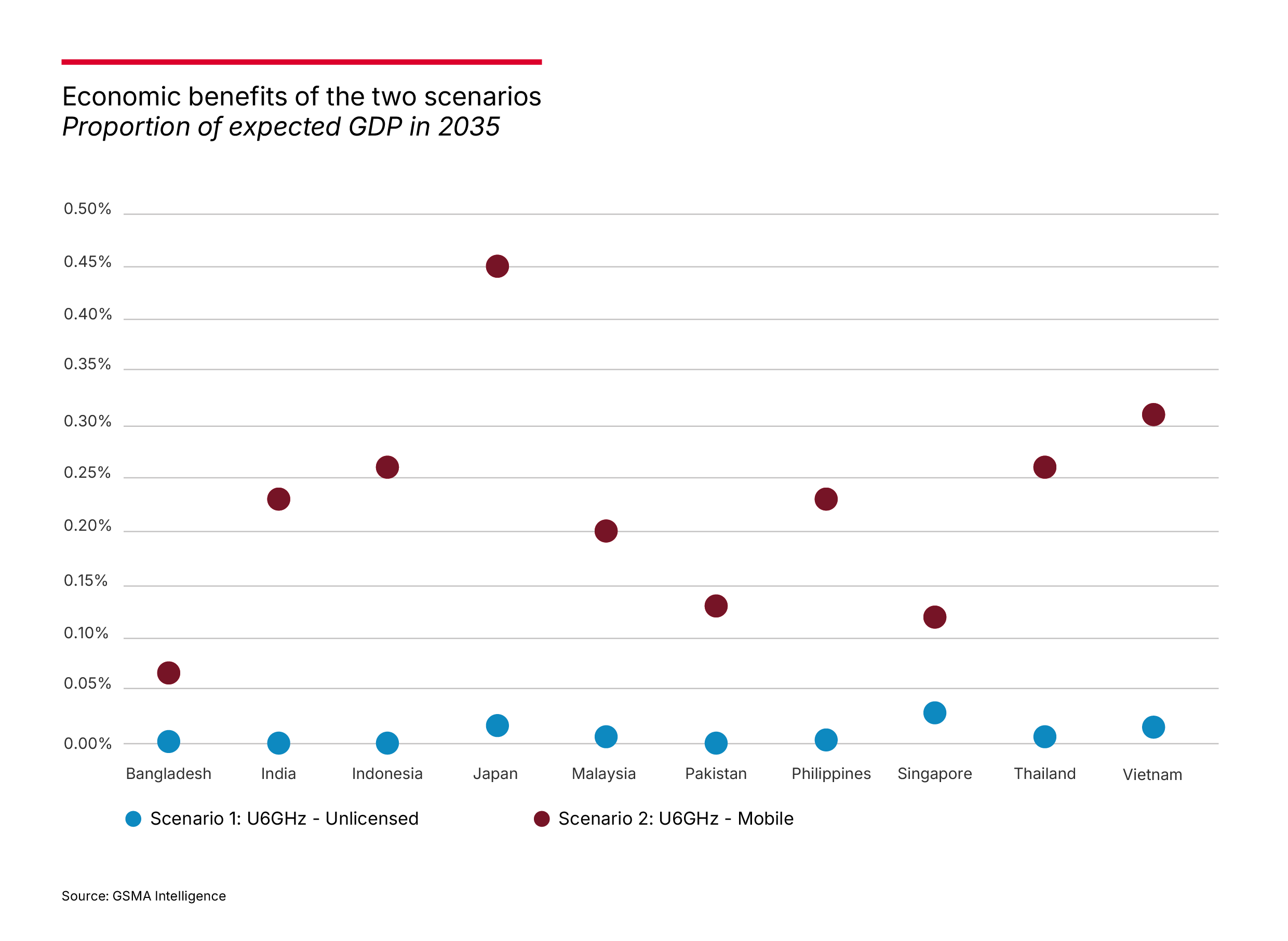
Capacity demand is the driver behind the economic value generated by upper 6 GHz mobile. The GSMA Intelligence analysis of APAC cities shows that the greatest economic benefit is always achieved when the band is fully assigned to licensed, macro-cell mobile use. This is because – with Wi-Fi gaining new spectrum in the lower 6 GHz in many APAC markets – mobile networks are much more likely than Wi-Fi to face capacity constraints through to 2035. Additional spectrum is thus critical for enhancing network performance and broader economic value. supply to mobile and result in lower economic benefits.
Meeting the next decade of mobile demand
Globally, an average of 2–2.5 GHz of mid-band spectrum is estimated to be needed in high-population-density areas during the 2035–2040 timeframe. In higher-demand countries, the requirement could exceed 3 GHz. Many countries currently have around 1 GHz of mid-band spectrum allocated to mobile, which means approximately 1–2 GHz of additional spectrum will be needed over the next decade.
APAC is a driver of these needs. From the mobile-first economies of South Asia to the highly digitalised East Asian markets, spectrum needs will be among the highest in the world.
Wi-Fi expansion is already assured
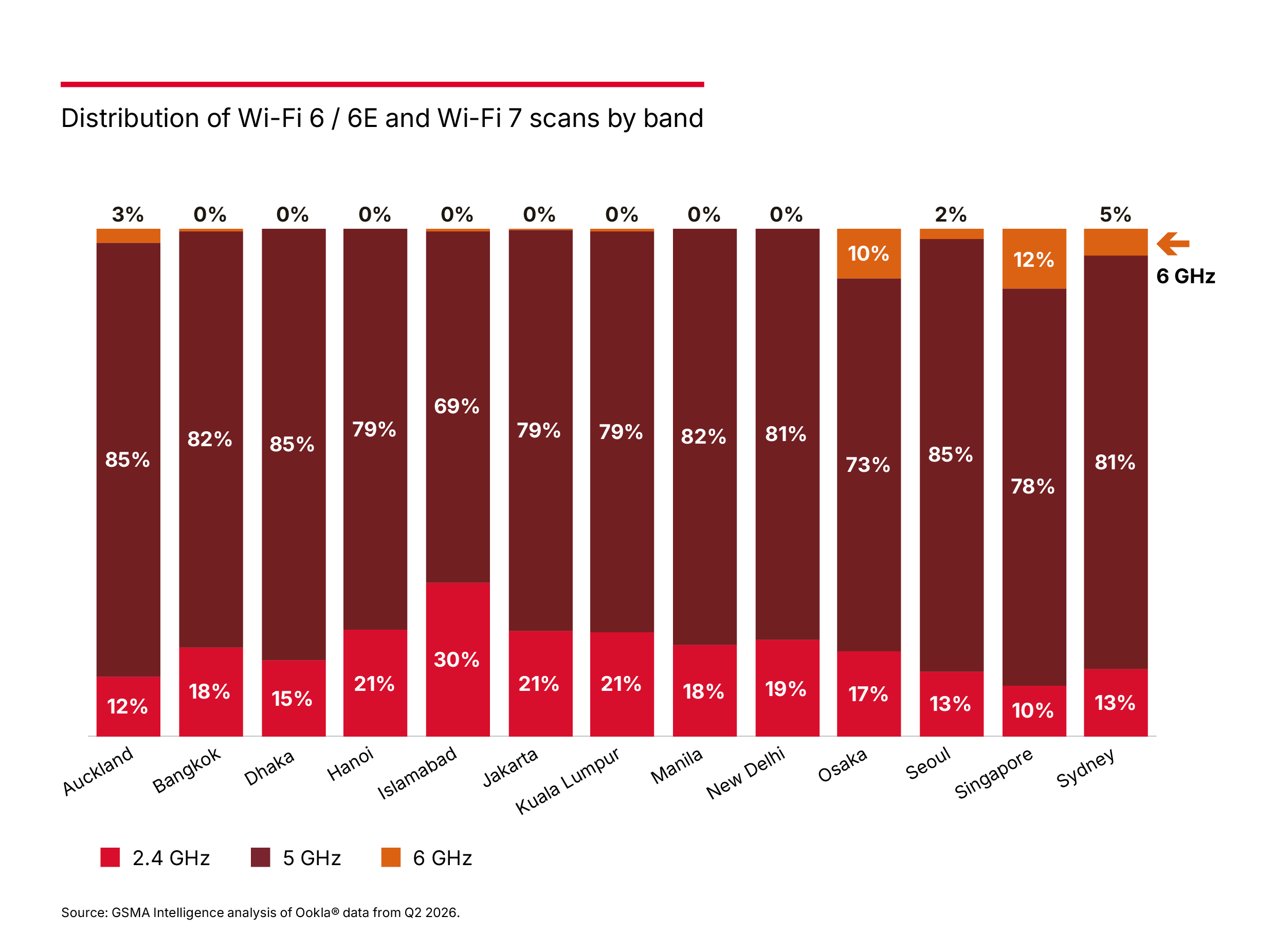
The economic value for using mobile in the upper 6 GHz band is higher than Wi-Fi because other unlicensed spectrum is available: planning for licensed mobile does not mean overlooking Wi-Fi. In many APAC markets, the lower 6 GHz band, 5.925–6.425 GHz, has already been made available and offers an expansion band through which Wi-Fi can evolve. Today the 2.4 GHz and 5 GHz Wi-Fi bands carry most of the Wi-Fi traffic in major APAC cities, while use of 6 GHz by Wi-Fi 6E and Wi-Fi 7 generally has remained limited. The lower 6 GHz can be used for Wi-Fi expansion while the upper 6 GHz can allow regulators to meet mobile demand.
The future of mobile
Mobile spectrum needs have evolved with each generation, and it is crucial to develop spectrum roadmaps that will pave the foundations of mobile connectivity in the next decade. In this regard, the following aspects will be key:
- 6G will use mid-band channels of 200–400 MHz per network to provide the capacity and speeds to enable future applications, such as integrated sensing and communications (ISAC) and AI-enabled services.
- Most mid-bands in the 3.5 GHz range and below are already heavily utilised in most markets for existing networks supporting 4G and 5G networks. The upper 6 GHz band should be planned alongside expansion into 7 GHz to allow wide 6G channels for APAC markets.
- Mobile needs are indoors and outdoors – GSMA Intelligence analysis of major APAC cities found that around two-thirds of mobile use was indoors with mid-bands providing 85% of indoor connectivity.
- 6 GHz can provide indoor coverage, comparable with the 3.5 GHz range, and can be deployed on the same network grid rather than building additional sites.
Governments and regulators in APAC that prioritise full-power, licensed mobile use in the full upper 6 GHz band will realise the greatest economic value from the band. Alongside continued Wi-Fi expansion in existing unlicensed bands and lower 6 GHz, this offers a balanced basis for supporting connectivity as APAC advances from 5G towards the 6G era.