Home
...
Mobile: Powering Progress
Foundations of the Digital Economy
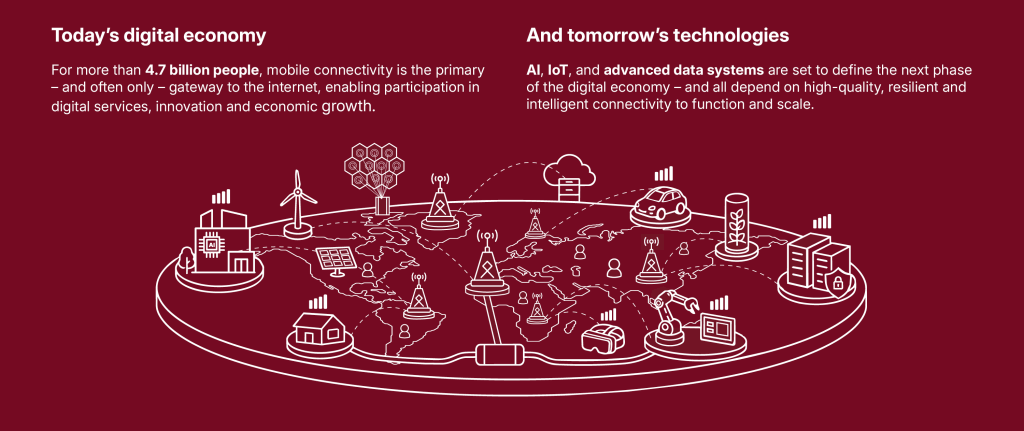
The digital economy is only as strong as the networks it runs on. As the foundation of both today’s digital economy and tomorrow’s technologies, mobile must be empowered to deliver high-quality, resilient and intelligent connectivity at scale, worldwide.
Policies that support the mobile economy unlock opportunities for all
Policymakers can enable this by streamlining permitting processes, reviewing sector‑specific taxation, removing barriers to network deployment, and providing long‑term licensing certainty.
At the 2026 Plenipotentiary Conference, the GSMA urges Member States to focus on strengthening three key foundations of the digital economy:
Usage Gap
A lack of affordable devices – compounded by limited digital skills, a scarcity of relevant content and online safety concerns
- keeps billions of people offline. Closing the usage gap requires policies that reduce device taxes, enable financing and invest in digital skills.
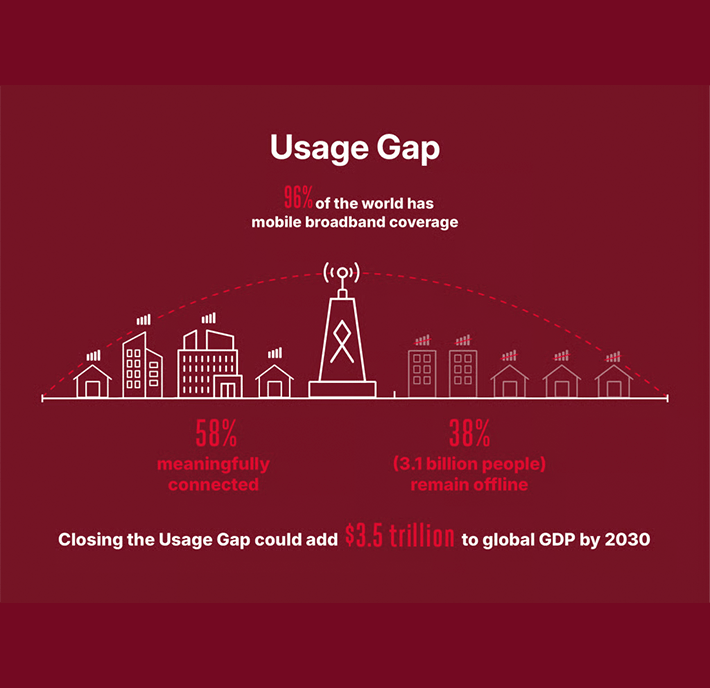
- 96% of the world’s population are served by mobile broadband networks – yet 38% remain offline.
- In low- and middle-income countries (LMICs), 43% of people cannot afford a smartphone; for the poorest, even a basic handset can cost up to 48% of monthly income.
- Closing the usage gap could add $3.5 trillion to global GDP by 2030 – with more than 90% of that value flowing to LMICs.
To find out more about closing the Usage Gap, visit the Breaking Barriers – Closing the Digital Divide page. You can also read the latest policy papers that provide analysis and recommendations on addressing the main barriers to the Usage Gap.
Sustaining and Extending Network Infrastructure
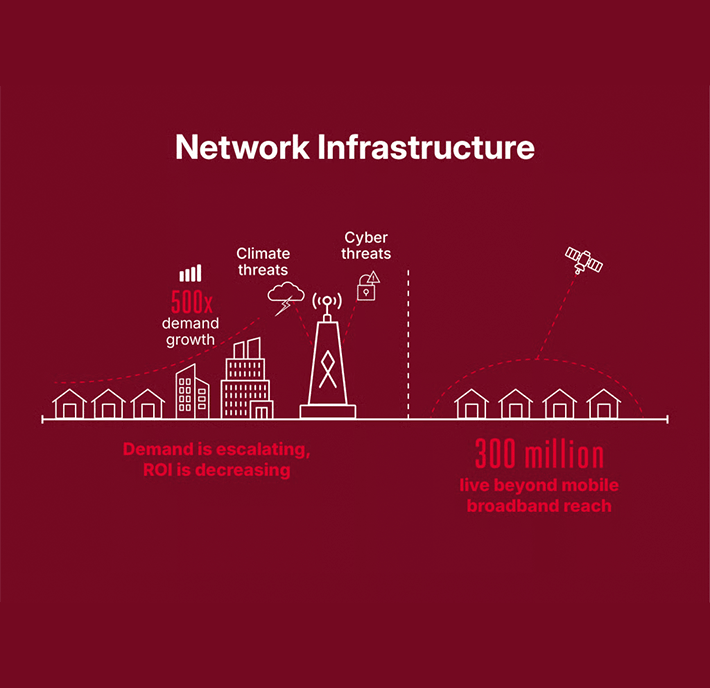
- Since 2010, global mobile traffic has grown more than 500-fold – and the demands on networks continue to multiply.
- Networks must now support AI-enabled innovation, withstand growing climate and cyber threats, and ensure reliable emergency and humanitarian communications – all of which require resilient, intelligent infrastructure capable of predicting demand and responding in real time.
- Meanwhile, around 300 million people still live beyond the reach of mobile broadband. Space-based solutions such as direct-to-device (D2D) services can help close this coverage gap, but consumer affordability, particularly in LMICs, remains a key barrier.
- Each of these priorities – carrying surging traffic, modernising infrastructure, securing networks and extending coverage – competes for the same finite pool of capital, at a time when operators’ returns on invested capital have fallen.
For more insights on maintaining and extending network infrastructure, visit our Policy and Regulation page and read the related reports
Forward-Looking Spectrum Management
Spectrum is the natural resource that underpins all mobile connectivity. How it is planned and managed directly determines the world’s access to connectivity. Forward-looking spectrum management
- Prioritising low-band spectrum for rural coverage: Harmonising and assigning low-band spectrum to mobile enables base stations to cover wide areas at lower costs.
- Enabling mid-band spectrum innovation: More than 50% of urban residents will face capacity constraints by 2030, and networks supporting AI and data‑intensive applications will require 2–2.5 GHz of mid-band spectrum by 2035–2040. Reaching this goal requires international consensus by 2030.
- Ensuring satellite-terrestrial coexistence: Spectrum frameworks should enable satellite innovation without compromising the terrestrial networks that connect billions of people.
To find out more about forward-looking spectrum management, visit our spectrum pape and read these related reports.