MWC26 Barcelona placed an important spotlight on humanitarian issues this year.
High‑level and widespread engagement from humanitarian actors, the mobile ecosystem and governments demonstrated the progress we are making to harness public–private partnerships and digital technology to address growing humanitarian challenges globally. This centered around two global humanitarian initiatives that the GSMA Mobile for Humanitarian Innovation programme plays a leading role in – Connectivity for Refugees and Early Warnings for All.
At a time when conflict, displacement and climate‑driven disasters are increasing in frequency and severity, MWC26 showed that the mobile industry is not only ready to engage, but already delivering tangible impact at scale. Across the week, humanitarian issues were present in ministerial discussions, on public policy stages, and in closed‑door roundtables with operators, governments, foundations and multilateral organisations.

Recognition of the importance of these issues started on the eve of MWC26 when the ITU Secretary-General, Doreen Bogdan-Martin, and the Deputy High Commissioner of the UN Refugee Agency, Kelly Clements, received the GSMA Chairman’s Award for Keeping the World Connected in Crisis. Recognising this work as one of the most innovative and impactful initiatives across the global mobile and digital ecosystem shows just how central humanitarian connectivity has become to the industry’s shared priorities, and the role the mobile ecosystem can play in supporting people affected by crisis.
Connectivity for Refugees in the Ministerial Programme
The Ministerial Programme opening session continued this theme, with the UNHCR Deputy High Commissioner, the ITU Secretary General and the OECD Secretary General joining John Giusti, GSMA Foundation President for a discussion on Connecting a World in Motion. The discussion reflected how to strengthen global digital policy cooperation and public-private collaboration to drive prosperity and progress for all – including refugees and those hardest to reach.
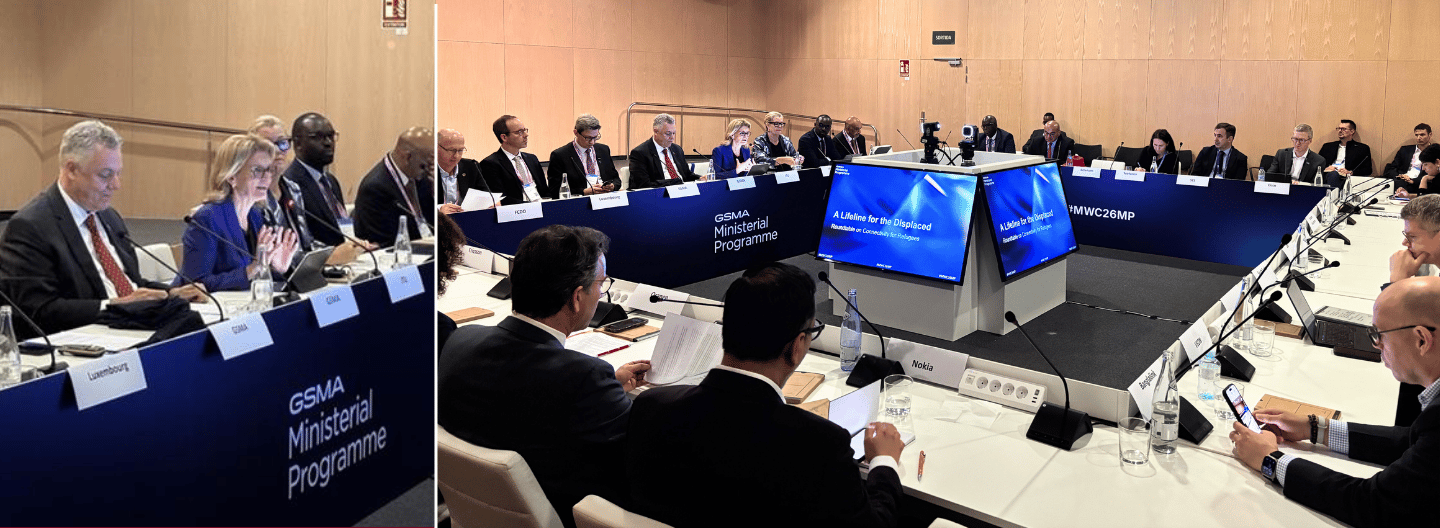
The momentum continued with a high-level roundtable “A Lifeline for the Displaced” hosted by John Giusti that brought together governments, industry, humanitarian agencies and development partners. A video showcased the recent Chad field visit of the Connectivity for Refugees initiative, followed by opening remarks from Doreen Bogdan-Martin and Kelly Clements.
The roundtable included comments from the Rwanda Ministry of ICT, Luxembourg MFA, UK FCDO, Sida, Orange, Eutelsat, SES, Airtel Africa, Cisco, Telefónica, Nokia, UNDP, Safaricom and the World Bank. Discussion focused on recent progress, insights from the Chad visit, the need to expand partnerships, invest in digital skills, and ensure long-term sustainability so that connectivity supports local economies and delivers sustainable outcomes for operators alongside social impact.
Reflecting the deepening relationships in the Connectivity for Refugees Initiative, MTN and UNHCR signed a partnership during MWC26 to expand connectivity for displaced communities across Africa, starting in Rwanda and other key markets.
Mobile alerts save lives
With 96% of the world’s population covered by a mobile network and 5.8 billion unique mobile subscribers – the stakeholders represented at MWC26 Barcelona are the ideal constellation of partners to achieve the UN Secretary General’s aim of protecting everyone in the world with an early warning system.
The “Mobile Alerts Save Lives: Industry Perspectives” panel showed the excellent progress that has been made. Speakers from mobile network operator KDDI in Japan, operators from the Pacific Islands and the International Telecommunication Union who lead Pillar 3 of the Early Warnings for All initiative focused on “warning dissemination and communication”, all spoke to the partnerships that are needed to deliver effective early warning systems.

The discussion grounded the conversation in lived reality, particularly for disaster-prone Pacific Island populations, highlighting the lifesaving value of mobile-enabled alerts. Speakers also reflected on the brand trust for mobile network operators, and the critical role of Cell Broadcast in delivering fast, reliable alerts at scale. Recently launched GSMA reports on world class early warning systems in Japan, France and Chile helped to demonstrate what is possible when mobile network operators, governments and other stakeholders collaborate to protect disaster-prone communities.
Innovative humanitarian solutions were profiled at MWC26. GSMA Innovation Fund grantee ConnectHear attended and showcased its AI technology providing online sign language interpretation and AI-generated alerts designed for low-internet connectivity environments and low-end handsets. The solution aims to support 1.35 million at-risk Deaf individuals in disaster-prone areas and over 10 million people with hearing impairments across Pakistan. ConnectHear CEO and Co-Founder Azima Dhanjee presented the work at 4YFN sessions and roundtables and received the Mobile Frontier Award.
Our Mobile for Humanitarian Innovation programme also had the opportunity to join the Eurasia roundtable to discuss development of mobile-enabled early warning systems in the region. Enthusiastic engagement from operators, government and regional bodies boosted plans for this region including progress towards a regional workshop in Tajikistan that will translate this momentum into action.
Humanitarian issues at the heart of MWC26 discussions
Alongside these events, our team enjoyed the opportunity to sit down with existing and new partners and are encouraged by the growing interest to leverage innovation and connectivity to address humanitarian challenges. Taken together, these moments at MWC26 Barcelona point to a clear direction of travel: humanitarian connectivity and digital humanitarian services are no longer peripheral to industry conversations, they are central to how the mobile ecosystem contributes to resilience, inclusion and sustainable development.
This initiative was funded by UK International Development from the UK government and is supported by the GSMA and its members. The views expressed do not necessarily reflect the UK government’s
official policies.