In May 2021, GSMA launched the Innovation Fund for Digital Urban Services, supported by the UK’s Foreign, Commonwealth & Development Office (FCDO). The fund supported start-ups using digital technology to enhance the accessibility, reliability, sustainability, and affordability of their solutions. Among the companies selected were: ATEC in Bangladesh, Diyalo in Nepal and Freetown Waste Transformers (FWT) in Sierra Leone. In 2024, these three grantees were selected to join the Accelerated Growth Round (AG Round), a 10-month follow-on funding round designed to support scaling. This blog reflects on how each grantee progressed during the AG round, looking at what changed, what scaled, and what lessons emerged.
Key outcomes from the AG Round
* Impact data has been provided by the grantee organisations

Under the initial GSMA grant, ATEC, a clean cooking company, launched a mobile application that allows users to track electricity usage and the carbon credit generation associated with their electronic cookstoves. The app also provided access to customer service support and facilitated digital payments. By the end of the grant, 4,464 users had adopted the stove, with affordability, ease of use, and safety cited as key adoption drivers. The shift to electric cooking also reduced carbon emissions by 1,705 tonnes during the initial grant period. Building on this, ATEC secured a long-term agreement with ENGIE for the purchase of up to 11.5 million tonnes of digitised carbon credits.
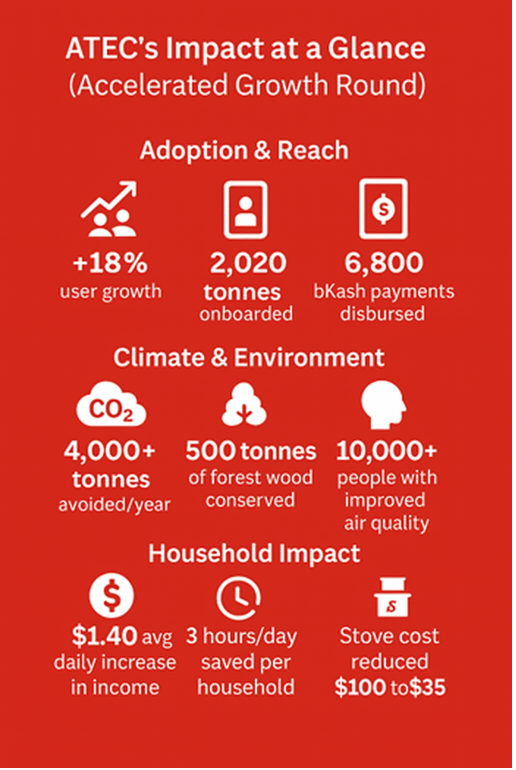
During the AG round, ATEC shifted focus from driving adoption to promoting sustained, daily use of the eCook stove and strengthening the commercial model. ATEC introduced a gamified “cook-to-earn” system via its mobile app, rewarding households that met a 2-kWh daily target with financial incentives through bKash (75 Taka/week for 14 kWh, 100 Taka for 21 kWh). For low-income households on Bangladesh’s subsidised electricity tier ‘lifeline’, the incentive amount would fully offset the cost of cooking with the eCook stove. ATEC also distributed smartphones to high-usage households as an additional incentive. Over the AG round, ~6,800 mobile money payments were made and ~220 smartphones distributed.
During the AG round, ATEC chose to shift from a PAYG model and instead used its carbon credit revenue to implement an up-front price subsidy that reduced the stove price from $100 to $35. Paired with expanded offline distribution and targeted digital campaigns, this approach drove an 18% increase in ATEC’s user base during the AGR period, with the shift removing a key barrier for low-income customers.
The combination of incentives and pricing reform led to sustained behaviour change among users. By the end of the AGR period, 17.1% of app users were consistently meeting the 2-kWh daily target, contributing to an annual reduction of over 4,000 tonnes of greenhouse gas emissions, improved indoor air quality for more than 10,000 people, and conservation of over 500 tonnes of forest wood. For low-income households, the gains were both financial and practical, families reported an average daily income uplift of $1.40 and reclaimed up to three hours a day once spent collecting fuel or managing inefficient stoves. The long-term off taker agreements for the carbon credit were a key enabler of the model, ensuring the extra usage and carbon savings translated into revenues that could be distributed as financial incentives.

The initial grant supported Diyalo to enhance their water utility Enterprise Resource Planning (ERP) system ‘Watermark’. Specifically, they added an android mobile app for customers, smart sensors to detect leaks, and a dashboard to help utilities monitor operations in real time. These upgrades enabled digital payments, mobile meter readings, and improved operational oversight for utilities, while customers benefited from easier payments and access to service information. This resulted in significant improvements: 43% digital payment adoption at pilot sites, a 10% average drop in non-revenue water, a 14% increase in monthly revenue, and five utilities achieving over 10% operating cost reductions. Diyalo’s client base expanded from 175 to over 800 utilities, serving roughly five million people (a fifth of Nepal’s population).
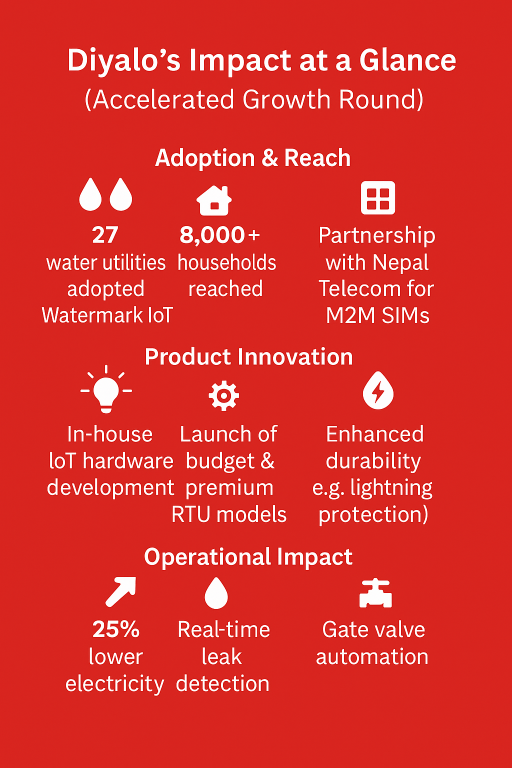
In the AG round, Diyalo focused on making IoT integration affordable and practical for small and medium-scale utilities. Central to this effort was the shift to in-house development of its IoT hardware, enabling end-to-end control over hardware cost, design, functionality, and integration with the Watermark ERP. This autonomy allowed Diyalo to upgrade its printed circuit boards (PCBs) and internal electronics, significantly enhancing the system’s durability and its ability to withstand voltage fluctuations and lightning strikes, common risks in Nepal. The shift also enabled faster development cycles, allowing Diyalo to incorporate feedback more directly to meet utility needs.
Diyalo also introduced premium model and economic versions of its Remote Terminal Unit (RTU). Essential components, RTUs connect sensors and mechanical components – like pumps and valves – to enabling remote automation and real-time monitoring. Diyalo’s economic RTU reduced hardware costs by approximately 20–25%, making IoT integration more accessible to smaller utilities that had previously been priced out.
Collectively, these interventions allowed Diyalo to expand their reach, securing 27 new water utility clients, ultimately benefiting over 89,000 people. The integrated solution also drove tangible performance improvements for utilities. Electricity costs dropped by up to 25% as pump operations shifted to off-peak hours; non-revenue water was reduced through real-time leak detection in both production and distribution networks; and labour efficiency improved as gate valve automation reduced repair times and freed up staff.
Freetown Waste Transformers (FWT) is an integrated waste management company leveraging digital platforms and its waste-to-energy facilities to improve urban sanitation and recover value from organic waste. The initial grant, supported FWT in developing DortiBox, a platform designed to digitise waste collection in Freetown. By the end of the grant, over 300 waste collectors were using DortiBox to serve more than 46,500 residents across Freetown, diverting 12 tonnes of organic waste from landfill and generating 12,205 kWh of clean energy. FWT also integrated DortiBox with Africell and Orange mobile money platforms, enabling digital payments for waste services.
In the AG round, FWT launched Dortibox 2.0, an upgraded, more inclusive version of its digital waste management platform. A key innovation was the introduction of a USSD service (*380#), developed in partnership with Orange Sierra Leone, which allowed waste collectors and users without smartphones to access the platform. To further expand accessibility, the platform incorporated voice prompts in both Krio and English, as well as visual symbols to support low-literacy users. These improvements addressed a challenge observed during the initial grant, where adoption lagged due to limited smartphone access and low digital literacy among waste collectors.
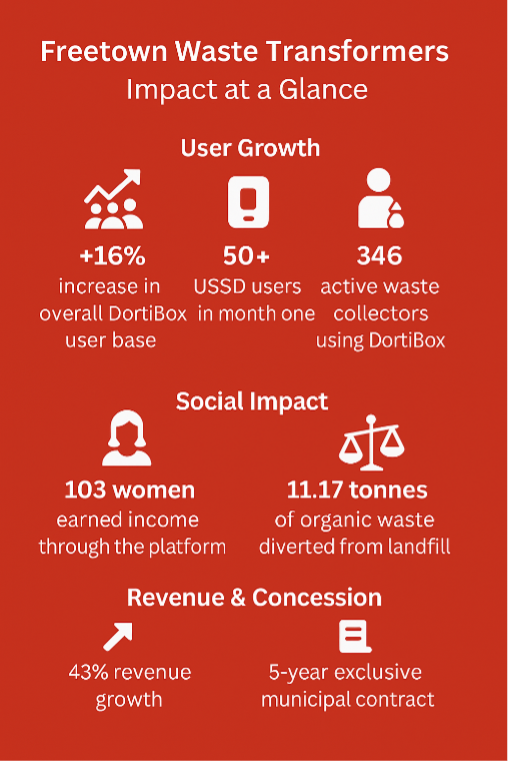
FWT also ran community engagement campaigns to raise awareness, improve digital confidence, and train users – particularly vulnerable groups – on how to engage with both the app and USSD. As a result, over 50 waste collectors and households accessed the platform via USSD in the first two months after its launch, highlighting a strong demand for inclusive options. This early momentum contributed to a 16% growth in the overall DortiBox user base over the grant period. Among waste collectors specifically, active users increased from 300 to 346, reflecting a similar positive trend in platform adoption. Dortibox’s growth enhanced the company’s ability to collect and analyse operational data, improve customer targeting, and optimise logistics across its growing user base. These efforts helped to divert 11.17 tonnes of organic waste from landfill and enable more efficient operation of FWT’s bio digestion units.
These changes also translated into strong commercial performance as FWT’s revenue increased by 43% during the project. Perhaps most significantly, FWT’s DortiBox app was adopted by Freetown City Council as the official digital infrastructure for citywide solid waste management operations and the company secured a five-year municipal concession for Block 6, covering over 15,000 registered customers and requiring use of its weekly collection service.
Key lessons across the cohort
- In underserved markets, scaling requires adapting solutions to the financial, behavioural and operational realities that define access. All three grantees evolved their strategy to address the specific conditions limiting uptake and long-term use. ATEC focused on driving daily use through behavioural incentives and addressed device affordability. Bringing IoT hardware development in-house, enabled Diyalo to develop cost-sensitive deployment models to serve smaller utilities. FWT enhanced its platform design with USSD access, voice prompts in Krio and English, and visual icons to support low-literacy users—while also embedding its solution within the city’s formal waste system. In each case, scale was not simply a matter of growing demand, but of enabling it. This is a lesson that is common across many of the 140+ organisations under the GSMA Innovation Fund, and what it takes to scale digital innovation in emerging economies.
- Financial sustainability depends on capturing value beyond the user. The three grantees strengthened their business models not by raising prices for end-users, but by realising operational efficiencies and diversifying revenues through institutional contracts and monetising environmental outcomes. ATEC leveraged usage data to generate carbon credits, unlocking a recurring revenue stream that reduced the stove’s upfront cost from $100 to $35. FWT’s five-year municipal concession to deliver waste services expanded their market and provides a predictable revenue stream through government-backed service delivery.
- Strategic pivots are central to scale, not symptoms of failure, and in the AG round the digital systems played an essential role in this shift. ATEC’s use of IoT to track stove usage and generate verifiable carbon data enabled it to access long-term carbon revenues – funding both price reductions and ongoing incentives for low-income households – and would not have been possible without the digital monitoring of usage. FWT transitioned to a B2G model grew from the partnership built on the Freetown City Council adopting DortiBox as the official solid waste management platform for the city. Diyalo’s expansion into in-house hardware development was only a viable evolution given the strong foundation of trust they had built with their utility clients through the Watermark ERP offering.
- Blending online and offline marketing strategies remains key, even with digitally enabled products. While digital channels are increasingly important, integrating offline distribution remains vital for extending reach, particularly in contexts with limited digital penetration. ATEC expanded retail and dealer networks and ran localised video campaigns to reach users with limited digital access. However, during periods of political unrest and flooding, offline sales were significantly disrupted but the presence of parallel online efforts such as social media outreach, ensured continued user acquisition and sustained visibility. FWT combined digital onboarding with field training and community workshops to ensure adoption across diverse literacy levels. Diyalo used live demonstration sites to showcase its solution, enabling utilities to visit, observe the solution in action and gain confidence in its effectiveness.
Continuing momentum
The Accelerated Growth Round has shown that scaling is not only about reaching more users, but about redesigning the models, incentives, and delivery systems that make that reach meaningful and sustainable. Since the close of the grant, FWT has secured additional investment and cemented its role within Freetown’s formal waste ecosystem. Diyalo is expanding its market presence through strategically positioned, high-performing demonstration sites that showcase impact, build trust with utilities, and catalyse adoption in surrounding regions. ATEC has raised over $3 million in new funding and initiated a new carbon finance project in Malawi, under a bilateral agreement with Switzerland, leveraging its IoT-based dMRV platform to generate auditable carbon data and channel carbon revenue to women adopting electric cooking. The progress made by ATEC, Diyalo, and FWT reflects wider trends across GSMA Innovation Fund cohorts, where early-stage catalytic funding alongside tailored scaling support has enabled grantees to secure new funding, deepen their impact, and scale in complex environments.
The Digital Utilities programme is currently funded by UK International Development from the UK government, and is supported by the GSMA and its members.