


Latin America and the Caribbean is home to 638 million people, living across a diverse range of 50 countries. Despite rapid growth in the last few years, nearly half of those living in the region – more than 300 million people – currently don’t subscribe to mobile internet services. For mobile broadband (3G and 4G), this is even lower: only 3 in 10 people have a mobile broadband subscription.
A common (but mistaken) assumption is that the low mobile internet penetration is due to a lack of network coverage. However, only about 10% of the region’s population, 64 million people, live outside the footprint of 3G or 4G networks. While this represents an ongoing issue (and one explored further in our recently published report: Closing the coverage gap: Digital inclusion in Latin America) compared with other developing regions, this is a relatively small coverage ‘gap’, with 24% of Asia Pacific, 25% of MENA and 57% of sub-Saharan Africa currently lacking mobile broadband coverage. However, despite the wide availability of mobile networks, 57% (or 360 million) of those Latin Americans who have coverage do not use mobile broadband. For mobile operators, this staggering gap represents an inability to unlock the commercial opportunity from their extensive capital investments across the region.
Moreover, given the potential of the internet as an enabler of social development and economic growth, this also represents a missed opportunity to enrich millions of lives across the region. It also underlines the key message of The GSMA’s Connected Society Programme: digital inclusion is about more than just coverage, it is also about the affordability of services, equipping users with digital skills and ensuring there are opportunities for users to create and consume relevant local content (taken to be any form of electronic media: pictures, music, text, videos, games, maps etc).
In order to further understand what was holding back the growth of the internet, we surveyed consumers across 8 countries in the region as part of the GSMA Intelligence Consumer Survey 2015 (Argentina, Brazil, Chile, Colombia, Guatemala, Mexico, Nicaragua and Puerto Rico). This revealed that the largest barrier to mobile internet access among the unconnected is a lack of relevance, which is directly driven by a lack of locally relevant content. In 6 of the 8 markets this was the largest barrier, while in the other two (Chile and Nicaragua) it was the second largest barrier (behind digital skills).
Figure 1: Biggest barriers to getting online for non-mobile internet users in Latin America and the Caribbean
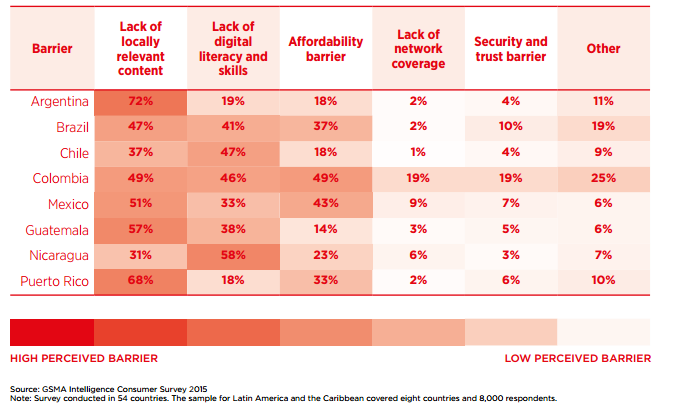
These findings should be a wake-up call for those working in and with the mobile industry in Latin America and the Caribbean, including policy makers. Fundamentally, there remains a strong perception among non-users – 40–50% of adults – that the online content and services currently available are largely irrelevant to their would-be digital experience. Solving this is crucial, and will require concerted and coordinated efforts from governments, operators and others in the mobile ecosystem. The evidence could not be any clearer: only focusing on solving the supply-side challenges is not sufficient, as much emphasis needs to be placed on measures to stimulate demand.
Read more in: Content in Latin America: Shift to local, shift to mobile
This report is one of a three-part series on digital inclusion in Latin America. The other two reports discuss network coverage and an overall analysis of digital inclusion barriers in the region.