


Case Study 4: EBI – Energy from biomass for telecom towers and communities in Bangladesh
In 2013, we launched the M4D Utilities Innovation Fund (formerly MECS) to test and scale the use of mobile to improve or increase access to energy and water services. With the support of the UK Government, GBP 2.4 million in Seed and Market Validation grants was awarded to 13 organisations in 11 countries across Africa and Asia.
Today we continue our Case Study series on lessons learned from these 13 projects. A core output of the Innovation Fund is the lessons and evidence base developed throughout the grant timeline that can inform ecosystem players, such as commercial benefits to mobile operators, and social and economic impacts for the underserved. By making these lessons public, we intend to accelerate scaling and sector growth. Since the inception of these grants, we have already seen significant expansion and innovation to mobile-enabled products and services for water and energy delivery as well as sanitation, and the business models that support them.
Click here to read the full report.
The fourth case study in our series focuses on US-based company, Emergence BioEnergy, Inc. (EBI), a provider of biomass power in rural areas of Bangladesh.
In January 2014, EBI, in partnership with Grameenphone, was awarded a Seed grant to implement the Community Power from Mobile (CPM) model with a biomass-fuelled engine to power telecom towers, businesses and households in rural communities.
In the CPM model, a telecom tower serves as the anchor customer for an Energy Service Company (ESCO). The consistent and stable power requirements and bankability of contracts with mobile operators or tower companies make it easier for the ESCO to raise capital compared to a model where energy is provided only to the underserved community. The mobile network operator benefits from a green and cheaper source of energy for its towers and increased mobile usage thanks to the availability of phone charging services. Households and businesses in the vicinity of towers gain access to a clean electricity source for their energy needs. Essentially, telecom towers serve as a hub for energy access and economic activity, making each tower a source of increased prosperity for communities.
The key objectives of the grant were to:
• Deploy a biomass-fuelled Stirling engine to reliably generate power and meet the 99% uptime requirement of telecom towers; and
• Evaluate the commercial potential of the service to generate revenues from the sale of power and organic fertiliser, a by-product of energy generation.
It was further expected that smallholder farmers would be able to increase their incomes from their existing farming operations by selling biomass and gain access to energy for critical farming operations like irrigation.
During the project, EBI successfully:
• Achieved 20 hours of operation per day, at peak, at one of their sites;
• Powered two Grameenphone towers for a short period; and
• Charged lanterns for rental use by shop keepers and other businesses.
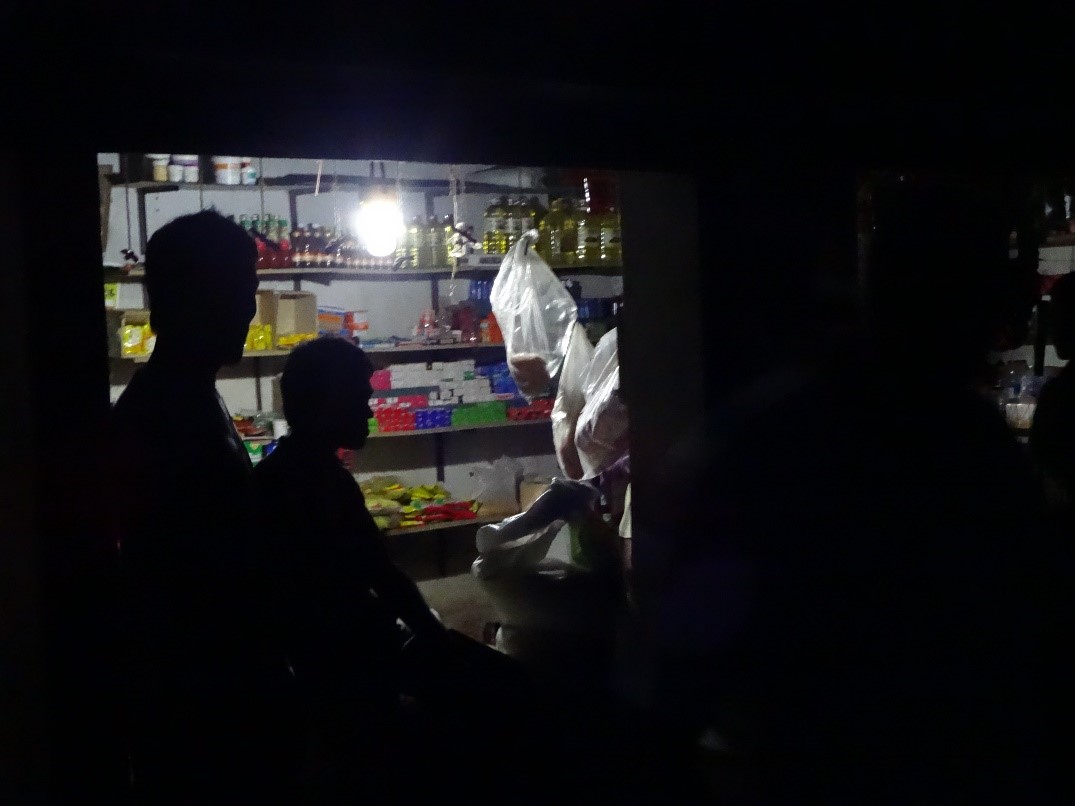
EBI lantern lighting up a shop
However, due to technical issues with the engine prototypes, EBI’s board of directors decided to halt operations in Bangladesh and ultimately to close down the company entirely in July 2015. Despite this outcome, important lessons emerged during the project, the most important of which are outlined below. All findings are explained in more depth in the case study.
Land constraints are a significant factor in biomass power generation
To meet the requirements of 24-hour operation, 1,200-1,600 square feet of land were required for the digester and associated infrastructure, which is larger than the area required for a standard telecom tower. Finding such a large plot of land in the vicinity of a telecom tower can be difficult. Furthermore, the site has to be in an off-grid area where ample biomass and water must be easily available. There must also be sufficient energy demand from the community, in addition to that of the telecom tower. Finally, neighbours around the site must be tolerant of the malodour.
Fertiliser sales presented unanticipated operational constraints
The secondary objective of achieving revenues from fertilizer sales could not be met as EBI was unable to sell the by-product. At the first pilot site, the quantity produced was too small to be of interest to commercial purchasers and the project was terminated before the second site produced the expected higher volume of fertilizer.
In conclusion, EBI’s goal to prove the technical and commercial feasibility of converting biogas into electricity to power telecom towers and meet other market demand for the electricity proved too ambitious for a 12-month project. Although the project failed to meet its objectives, the failure does not automatically suggest that Stirling engines do not have a future to power telecom towers. It is clear however that this technology needs more trialling before it can be successfully deployed commercially.
In the coming weeks and months we will publish more case studies to share insights from the other Phase 1 grantees. Follow the series by signing up to our blog and please share your views on any of these findings by contacting us at m4dutilities@gsma.com.