


As Hurricane Sandy touches down on the East Coast of the United States, the population is bracing for the impact of heavy rains and high winds, whilst emergency response personnel, utility companies and mobile operators prepare.
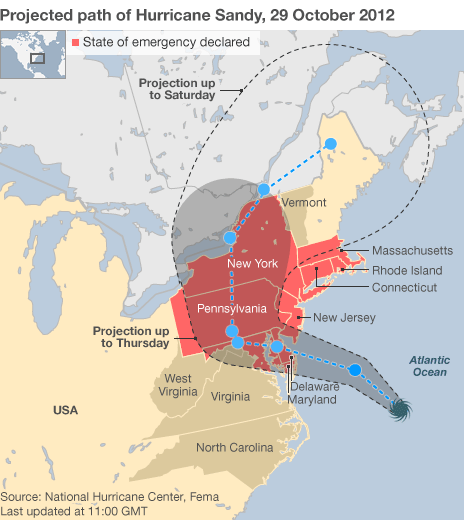
Hurricane Sandy has been picking up strength, having already taken the lives of 60 people in the Caribbean over the past few days. As of 12 pm GMT today, the US National Hurricane Centre forecasted that the storm has produced sustained winds of 85 mph, extending 175 miles. The hurricane itself is a massive 520 miles in diameter, and will cross as many as 12 American states in the next 24-36 hour period, with 50 million people potentially affected when it is expected to make landfall on Monday night. A State of Emergency has been declared in many of the affected states, with schools, transport and other services closed in anticipation.
At present, over 375,000 people have been evacuated from New York City. It is expected that there will be between $2-3 billion USD in damages from wind alone, with at least 10 million people being left without power for a week once the storm strikes.
The high winds, power outages and flooding predicted to accompany the storm present acute challenges for the continuity of the mobile network. However, many of the American carriers have implemented preparatory measures to help mitigate the impact on the networks, and on the provision of essential communication services for those affected.
AT&T:
In May 2012, AT&T became the first company to be certified by the US Department of Homeland Security in Disaster Preparedness under the DHS Voluntary Private Sector Preparedness Programme. In order to face the challenges presented by Sandy, AT&T has already deployed its Network Disaster Recovery (NDR) Teams to predicted affected areas to initiate any required restoration activities once the storm hits. These teams include highly trained personnel and 320 technical/equipment trailers to support troubleshooting and restoration. Other preparedness measures include:
- Topping up fuel tanks at at-risk cell sites
- Installing high capacity batteries
- Distributing portable generators for back-up power supply
- Activating pre-existing relationships with Regional and Local Emergency Operations Centres to restore or maintain service, and provide status updates until permanent repairs can be made
T-Mobile:
T-Mobile has staged its engineering teams to established zones and dispatched personnel to Network Command Centres throughout the Eastern Seaboard. T-Mobile has existing coordination points at local, state and federal levels to improve efficiency and knowledge sharing in response. Additionally, they have:
- Invested in supplemental cell-site back-up generators, microwave technology equipment and Cell-on-Wheels (COWS)
- Deployed COWS to neighbouring markets to increase wireless capacity to affected areas, including evacuation routes where congestion is likely to be a challenge
- Secured access to additional fuel supplies for generators and emergency transport vehicles
- Rolled-out back-up generators and fuel top ups for switches and generators in the storm’s path
Importantly, T-Mobile has also initiated its crisis plan for employees to ensure safety and security of its staff and facilities.
Sprint:
Sprint has developed Emergency Response Teams (ERTs) to provide short-term communications support, equipment and operations for federal agencies, local public safety officials, military and private sector companies. In anticipation of Hurricane Sandy, Sprint has dispatched its network recovery staff, as well as strategically positioned its ERTs. Throughout 2012, Sprint’s Natural Disaster Recovery Team carried out drills and exercises in disaster preparedness and response, including hurricanes, in the Northeast. They are also:
- Provided local public safety agencies in need of emergency communications support with 14 days of free-service using 25 ERT supported devices in areas where a “State of Emergency” has been declared
- Positioned “Network Strike Teams” on stand-by for rapid restoration
- Flood-proofed at-risk infrastructure and facilities and ensured generators are fully fuelled in at-risk areas
- Verified operation-readiness of generators and emergency equipment at all mobile switching stations and network points-of-presence (PoPs)
Verizon:
Verizon has suspended many of its non-emergency activities on the East Coast to focus on its response. Over the past two years, Verizon has invested $30.5 billion USD in fortifying its communication networks and infrastructure to make it more resilient to natural disasters. The company is monitoring its operations and the storm via national and regional command and control centres, and has initiated communication protocols with other utility providers to facilitate coordination of resources in the event of storm damage. The company has also:
- Taken a pro-active approach to communicating with customers in potentially affected areas via social media (Twitter, Facebook) and their website, and has sent emails to subscribers with key links for troubleshooting problems they may encounter with communications during the storm
- Verizon managers are communicating the company’s plans with public safety officials and various response agencies across governmental levels in affected areas
Staged emergency equipment and infrastructure such as COWs around mid-Atlantic and Midwest regionsImportantly, Verizon has raised the reality that whilst their own technicians may be ready to repair and restore storm-damaged facilities, they may be subject to approval from local power companies and first-response agencies. This underscores the importance of coordination and communication with other critical infrastructure providers and response agencies in advance of an emergency.All of the operators listed above have published tips for customers in coping with the storm, with emphasis on:
- Ensuring mobiles are fully charged, with back up batteries where possible and keep mobile dry and secure
- Store emergency contact numbers
- Have a car-charging adapter at hand so you can charge via your fuelled vehicle if necessary
- Limit non-emergency calls
- “Text-not-Talk” to reduce congestion
The American Red Cross has also launched a Hurricane app which allows users to monitor the storm, and communicate safety to friends and family via social media. The app also has downloaded tips and listings of Red Cross Evacuation Centres that can be accessed even if the mobile network is down.
To follow the mobile operators on Twitter to get live updates as they respond to Hurricane Sandy, follow them: @VZWNews (Verizon), @sprintnews (Sprint) @ATT (AT&T) @TMobile
Further Resources:
- http://www.nasdaq.com/article/telecom-companies-prepare-for-hurricane-sandy-20121028-00036#.UI5dpm8ifLM
- http://newsroom.sprint.com/article_display.cfm?article_id=2442
- http://news.verizonwireless.com/news/2012/06/hurricane-season-tips.html
- http://www.redcross.org/mobile-apps/hurricane-app
- http://www.att.com/gen/general?pid=1325
- http://www.guardian.co.uk/world/2012/oct/28/hurricane-sandy-new-york-impact
Photo credits: NOAA [top]; National Hurricane Center, Fema via BBC [bottom].