



The voluntary carbon market (VCM) presents startups with opportunities to unlock financial benefits for driving climate action. However, entering the market is not straightforward and many early-stage companies lack information on the expected costs and process for entering the market. The GSMA’s Mobile for Development programme recently published guidance for startups and early-stage companies considering entering the market. The Sanergy Collaborative is one of three case studies presented in the guide, more information on the VCM and the other case studies can be found here.
Sanitation represents a critical yet persistently overlooked global challenge. Today 4.6 billion people lack access to safely managed sanitation – 1.5 billion of whom are without access to basic sanitation services. The result is untreated and mismanaged human waste that contaminates water sources and poses severe public health risks. The malnutrition costs from poor sanitation in African and Asian countries are estimated at a staggering 9% of GDP. This crisis is particularly acute in densely populated urban areas, where rapid urbanisation outpaces infrastructure development.
The negative climate impacts of poorly managed sanitation systems are only just becoming more fully understood. On-site sanitation alone (i.e. excluding emissions from sewer access) is estimated to generate around 5% of global methane emissions. Further, a recent analysis of emissions in Kampala suggests sanitation may represent more than half of their total city-level emissions. The emissions from sanitation are predominantly related to methane, which is a far more potent greenhouse gas than carbon dioxide, but it also has a shorter atmospheric half-life, meaning any action taken to reduce methane production will result in a slowing of heating more quickly.
A radical rethink of how to manage faecal waste from cities is needed, as mismanagement and poor onsite storage results in high methane emissions, while conventional safe management is energy intensive. The sanitation sector is also all too often cripplingly underfunded, meaning it is hard to achieve all three key goals of profit/commercial viability, serve low-income customers and dispose of waste safely (see below).
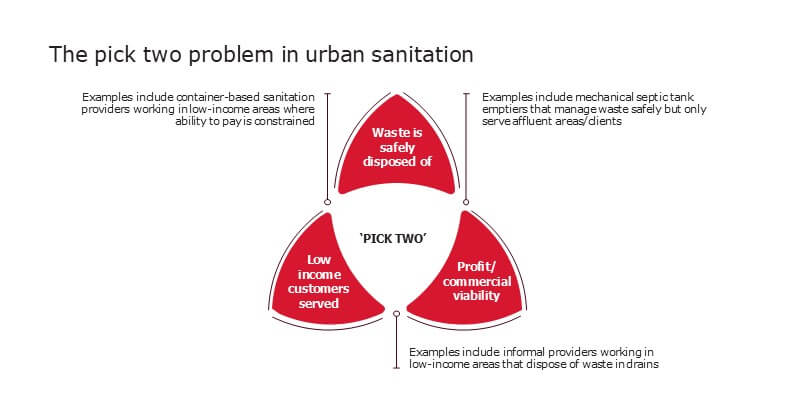
Source: GSMA. (2024). Making Circularity Work: How digital innovation enables circular economy approaches in waste management
Who are The Sanergy Collaborative?
In response, Nairobi-based The Sanergy Collaborative confronts this challenge through a three-step circular economy model that begins by providing safe sanitation systems, followed by waste collection services, and finally by transforming the collected waste into valuable upcycled products like fertiliser, animal feed and biofuels. Since 2011, through their Fresh Life brand, they serve low-income neighbourhoods in Kenya. Currently operating in three Kenyan cities – Nairobi, Kisumu and Eldoret – they serve 300,000 people every day, employ 350 people, and safely manage 20,000 tonnes of waste annually.
A member of the Container Based Sanitation Alliance (CBSA) and headquartered in Nairobi, they bring together several actors across the sanitation value chain working to offer better sanitation solutions for communities, reduce landfill usage and associated methane generation, improve the health of residents, and catalyse sustainable agricultural and energy production.
Entry into the carbon market
To reduce reliance on development partner funding, The Sanergy Collaborative is tapping into carbon finance. While there is currently no carbon methodology for toilet manufacture and distribution, existing methodologies related to waste management – such as ACM0022 under the UNFCCC Clean Development Mechanism – offer a viable pathway.
Sanergy’s emissions reductions stem from two key factors:
- Methane avoidance through composting waste that would otherwise decompose anaerobically.
- Significantly shorter containment times compared to traditional pit latrines or septic tanks, preventing any anaerobic conditions and methane generation from the waste.
Using ACM0022, Sanergy achieved a major sector milestone and began issuing the first carbon credits for container-based sanitation with the Verified Carbon Standard in November 2024. The project with Verra is driven by two core entities within The Sanergy Collaborative:
- Fresh Life: Manufactures low-cost, high-quality branded toilets, franchised to local entrepreneurs. It also provides waste collection, marketing, and training support.
- Regen Organics: Operates a waste treatment facility that converts waste into regenerative agricultural inputs and sustainable fuels for commercial use.
Because Sanergy is vertically integrated – owning both the toilets and the waste – it can claim full ownership of the resulting carbon credits. The number of credits generated is directly tied to the weight of waste treated and the number of toilets deployed. Notably, digital monitoring systems are not required, as the primary emissions reduction metric is the weight of waste processed.
Generating carbon credits
The carbon project development process took approximately 24 months, beginning with pre-feasibility work in mid-2022. Sanergy engaged experts throughout, including a consultant for feasibility studies and Project Design Document (PDD) development. For verification, they issued a Request for Proposals (RFP) to select a Validation and Verification Body (VVB). An early cost-benefit analysis, based on the volume of waste managed, indicated that generating 30,000 carbon credits annually would justify the investment. Estimated costs include:
- Upfront project development: ~$100,000
- Annual monitoring and verification: ~$50,000
To reduce recurring costs, Sanergy explored outsourcing Monitoring, Reporting, and Verification (MRV) but ultimately opted to build internal capabilities, cutting annual MRV costs to around $25,000. This strategic move underscores the value of internal expertise in managing long-term operational efficiency.
Beyond Sanergy, CBSA research on the viability of carbon credits in sanitation found that while the carbon savings were significant, the costs of entering the market were high and sanitation providers needed to be operating at scale to reduce the risk of not breaking even when entering the market.
Strategic choices and market interest
The Sanergy Collaborative chose Verra over Gold Standard due to their consultant’s experience and Verra’s lower credit issuance fees. Throughout the process, the importance of having qualified internal staff became clear – not only to support the consultant but also to gather and critically assess the data and assumptions underpinning the project.
They have begun engaging with potential buyers and are seeing strong interest in these first-of-their-kind carbon credits. Buyers are particularly drawn to the project’s methane abatement benefits and its broader co-benefits, including:
- Improved access to safe sanitation (SDG 6)
- Increased recycling and waste recovery (SDG 12)
The Sanergy Collaborative’s approach not only addresses urgent sanitation and environmental challenges but also demonstrates how circular economy models can unlock new avenues for climate finance.
New GSMA resource on carbon credits
Entering the voluntary carbon market (VCM) can be daunting for climate tech startups. Conversations with GSMA’s Innovation Fund grantees revealed a significant information gap, leaving many early-stage startups feeling ill-equipped to engage with the VCM. To address these needs, “The Voluntary Carbon Market: A guide for startups” from the GSMA ClimateTech programme, produced in collaboration with research partner Social Finance, provides accessible and tailored information designed to empower startups to independently evaluate their potential of entering the VCM. Read more about the guide here.