[This blog was last updated on Friday 20 February, 2026 since its first published date of Wednesday 26 November, 2025 to include DeepEcho, Cherehani Labs, PT Impactbyte and ToumAI in the list of our full cohort of start-ups selected under the GSMA Innovation Fund for Impactful AI]
Artificial Intelligence (AI) is redefining the technological landscape as the fastest-adopted general-purpose technology in human history. In just three years, over 1.2 billion people have engaged with AI tools, outpacing the adoption of the internet, personal computers, and even smartphones.
AI is more than just a technological breakthrough; it is a catalyst for systemic change with transformative potential across education, health, agriculture, climate resilience, and digital and financial inclusion. In education, AI can create adaptive and personalised learning pathways that help students overcome barriers to quality education. In health, it can strengthen frontline systems by supporting community health workers, enabling early disease detection, and guiding public health decisions through advanced analytics.
For agriculture, AI can guide smallholder farmers in local languages, providing insights on crop yields and resource optimisation, empowering them to improve productivity and adapt to changing climate conditions. It can also play a vital role in addressing climate challenges by analysing satellite and sensor data for modelling risks, forecasting extreme weather more precisely. Beyond these sectors, AI can help bridge digital and financial divides, creating opportunities for underserved populations to access essential services. When combined with local expertise and contextual knowledge, AI becomes not only powerful but deeply relevant, delivering solutions that reflect community realities and drive inclusive progress.
Yet, as with previous transformative technologies, its benefits are far from evenly distributed. While AI holds immense promise, its potential to tackle global challenges and deliver solutions tailored to the realities of low- and middle-income countries (LMICs) remains largely untapped.
The GSMA, with funding from the UK Foreign, Commonwealth and Development Office (FCDO) launched The GSMA Innovation Fund for Impactful AI in January 2025. The fund invited pitches from for-profit small and growing enterprises, leveraging AI and emerging technologies alongside mobile technologies to solve real-world challenges and deliver measurable impact in low- and middle-income countries (LMICs) across Africa, Pacific, South and Southeast Asia.
This fund is sector-agnostic, with priority given to applications that focus on one or more of the following:
- Digital solutions leveraging contextual data generated by emerging technologies for training and deploying AI-driven products and services.
- Digital solutions using predictive and generative AI innovations that show promise to scale and deliver positive socio-economic and/or climate-related impacts.
- AI-driven innovations that directly reach low-income and vulnerable populations and aim to advance socio-economic development and climate action.
- AI-driven deep-tech, ecosystem-level innovations that support local and regional ecosystems for last-mile innovators to deploy AI solutions.
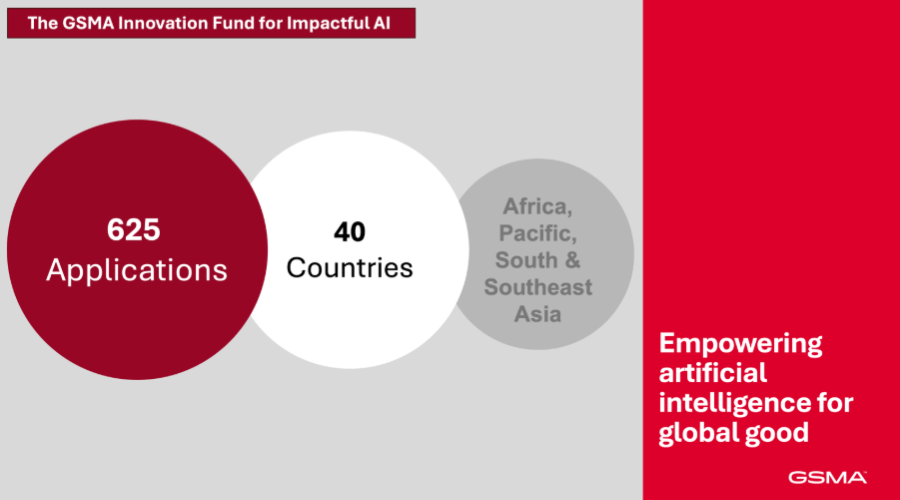
This funding round received 625 applications from 40 countries across Africa, Pacific, South and Southeast Asia.
We have summarised key trends from the applications in our blog here.
Following pitch, review and selection, we are delighted to present the eight grantees of the GSMA Innovation Fund for Impactful AI with the remainder of the cohort being announced in due course:

Millions of small businesses in Africa struggle to grow due to poor product selection, uncertain demand, and insufficient data. Without reliable market insights and steady sales, simply providing financing does not address the core problem of understanding what sells, when, and why.
Kola Market solves inconsistent income, poor inventory management, and limited financing faced by MSMEs in Ghana through AI-driven sales acceleration, inventory optimisation, and tailored off-balance-sheet financing through an AI-powered, mobile-first platform accessible via WhatsApp, SMS, and voice (including local languages).
With this grant, the company will enhance two-way voice interaction, expand feature phone access, integrate mobile money data for improved credit scoring, and pilot AI-guided micro-warehousing for efficient inventory delivery.
Students in rural Ghana face severe educational disadvantages due to information and digital access gap. While students in urban areas increasingly leverage tablets and high-speed internet, a large proportion of basic schools in Ghana lack functional ICT infrastructure. Students in rural areas are often limited to basic feature phones, preventing them from accessing the wealth of digital educational content and tools available to their urban counterparts. This disparity creates a systemic barrier, fundamentally limiting their academic potential and future opportunities.
Metaschool AI is an AI-powered learning platform designed to provide personalised, curriculum-aligned tutoring to all Ghanaian students. It aims to bridge the educational gap by offering accessible, affordable, and targeted support to help students prepare for Ghana’s national school exams.
With the support of the fund, the platform will scale across all device types, providing access via mobile and USSD/SMS for low connectivity areas, enhancing core features such as video lessons, interactive quizzes, progress dashboards, and integrating voice support with localised content.
Uptake of essential services in Nepal, including health insurance, financial products, agricultural support and key government services, remains persistently low. Limited literacy, low digital awareness and weak understanding of pricing and product options prevent many households from accessing the services they need. These challenges are even more pronounced for Maithili-speaking communities, Nepal’s second-largest native language group, who face an additional barrier because most information, platforms and service touchpoints are not available in their language.
Despite growing smartphone penetration nationally, many rural users, including large segments of the Maithili community, continue to rely on basic phones restricted to SMS and voice. As a result, they remain excluded from digital service channels that increasingly assume smartphone access and proficiency in Nepali or English.
Wiseyak is an Artificial Intelligence company specialising in AI-driven solutions that empower organisations with automation and data analytics across multiple industries.
Within this project, Wiseyak will use the funds to develop a multilingual mix-code (English-Nepali-Maithili) conversational AI solution to help reduce the digital divide caused by language barriers in Nepal. The solution will include speech-to-text (STT), text-to-speech (TTS), and voice-to-voice capabilities. The conversational AI capabilities will be designed for medium and large enterprises, including banks, insurers, agritech companies and mobile network operators, enabling them to offer easier access to their products and services for Maithili and mixed-language speakers.

In Pakistan, more than 1.5 million children with special needs lack access to specialised education and therapy, as only 550 registered institutions are available across the country, most of them concentrated in major cities. The shortage of trained professionals, high service costs, and travel difficulties further limit access, highlighting the urgent need for affordable, scalable solutions for the underserved communities.
WonderTree is a technology company that leverages AI and augmented reality (AR) to turn physical-therapy and special-education exercises into engaging, motion-based games. Designed for children with mild to moderate motor and cognitive challenges, these games help develop social, educational, and motor skills.
With this fund, WonderTree will launch a mobile application of its AI-powered digital learning platform to make learning more accessible, convenient, and affordable for children with special needs. They will also introduce Early Childhood Development (ECD) activities focused on cognitive, motor, and literacy skills.
In rural and underserved areas of Morocco, access to antenatal ultrasound is limited by a shortage of trained operators including obstetricians, radiologists, and midwives with ultrasound competencies, and by the high cost and complexity of equipment. Consequently, high‑risk pregnancy conditions such as pre‑eclampsia and foetal malpresentation are often missed or identified late, contributing to avoidable maternal and neonatal morbidity and mortality. Even where devices are available, they are frequently underutilised because midwives lack hands‑on training and equipment interfaces are overly complex. The high purchase and maintenance costs of advanced systems further constrain deployment in low‑resource settings.
DeepEcho is a healthtech company that uses AI to make prenatal ultrasounds faster, more accurate, and accessible, bringing quality maternal care to underserved pregnant women in rural Morocco.
DeepEcho will use the funds develop an offline-first mobile app to deploy and scale its AI‑assisted ultrasound kits in primary health centres that lack diagnostic infrastructure across underserved regions of Morocco, enabling earlier identification of high‑risk pregnancies. The app will run on smartphones and tablets, and work without connectivity, syncing securely when networks are available. The company will also train midwives and primary care workers to perform blind sweep scans and partner with local health authorities and NGOs to lead community and patient sensitisation, building trust and acceptance of AI-assisted diagnostics within routine antenatal care.
Smallholder dairy farmers in Kenya face high livestock morbidity and mortality due to limited access to timely, affordable and accurate veterinary diagnostics. Traditional testing options are often distant, costly and slow, leading to delayed treatments, reduced productivity, and financial insecurity. These challenges disproportionately affect underserved households, limiting their income, resilience, and access to essential services like credit or insurance.
Cherehani Labs solves livestock healthcare inequality by building a chain of solar-powered containerised veterinary laboratories in rural areas and providing zero-rated access to an AI-driven platform for translating lab results and recommending medical and dietary intervention to veterinarians via their mobile phones.
Cherehani Labs will use the funds to scale the AI core of its diagnostics management platform, accelerating and improving laboratory result interpretation for livestock health across a broader network of rural smallholder farmers in Kenya. Within this project, Cherehani labs will refine the AI model by conducting extensive supervised testing with human lab technicians, ensuring high accuracy and reliability in diagnostic outputs. It also aims to drive frontline adoption of AI-guided interventions through targeted, in-person training sessions for veterinary professionals.

Indonesia faces a significant learning crisis, with over half of late primary students lacking basic reading skills, especially in rural areas like Papua, which lags far behind urban regions such as Jakarta. Teacher absenteeism in remote regions has reached 34%, severely disrupting learning continuity. Additionally, poor infrastructure and limited internet access in these remote areas hinder the effectiveness of digital education tools, deepening the educational divide.
Impactbyte is on a mission to empower one million digital talents by 2030, equipping them with relevant skills to thrive in the digital economy. Through hands-on learning, an industry-driven curriculum, and professional mentorship, it bridges the skills gap and improves employability to drive socio-economic growth.
Impactbyte will use the funds to launch ‘GURU-BOT’, an offline-first, generative AI-powered learning platform for low-income elementary school students in rural areas with limited connectivity. The platform will help improve literacy and numeracy through self-directed learning exercises, speech and handwriting recognition, and gamified lessons. Key features will include a 24/7 offline AI tutor, real-time speech and handwriting recognition, and an adaptive learning system.
In Morocco, millions of low-literate and rural citizens remain excluded from digital and financial services as most apps and platforms use French or Standard Arabic rather than local dialects. High illiteracy rates, combined with limited connectivity and infrastructure, further hinder adoption of these digital services. Moreover, most digital services require stable internet and advanced devices, which are impractical for low-connectivity, resource-constrained environments in rural Morocco, collectively limiting access for underserved rural populations.
ToumAI is an AI company that creates voice interfaces in local dialects to help low-literate, rural users access digital and financial services through simple spoken interactions.
Within this project, ToumAI will develop a voice interface that works in local dialects of Maghrebi Arabic and Berber languages. By compressing large language models to run efficiently on budget smartphones and function entirely offline, the solution will work reliably in low-connectivity environments. This will help reduce language, literacy and connectivity barriers, making digital services accessible and usable for underserved rural communities in Morocco.
Over the 18 month grant period, GSMA will provide targeted support to the fund grantees, designed to strengthen their solutions and help scale their impact across low- and middle-income countries. This support will include:
- Tailored venture building support: Grantees will receive assistance focused on enhancing both their solutions and business models. This includes strategic guidance and hands-on support to ensure their innovations are robust, scalable, and well-positioned for long-term success.
- Facilitation of strategic partnerships: GSMA will help grantees forge connections with mobile operators, public sector organisations, and other relevant stakeholders to broaden the reach of their services and create opportunities for growth.
- Peer learning opportunities: Grantees will have access to structured knowledge sharing sessions with other innovators, promoting collaboration and sharing learnings across projects.
- Visibility and exposure: Through participation in GSMA’s global events, as well as presence in publications and online platforms, grantees will benefit from increased visibility, helping them connect with potential investors and partners, opening doors for further investment and scaling of their impact.
The GSMA is excited to be working with this passionate and extraordinary group of organisations, committed to accelerate the adoption and scalability of AI-driven innovations that address the unique needs of local populations in low- and middle-income countries.
Sign up to our Innovation Fund newsletter here to learn more about these and other GSMA grantees.
This material is an output from a project funded by the GSMA Innovation Fund for Impactful Al. This initiative is funded by UK International Development from the UK government and is supported by the GSMA and its members.
The views expressed do not necessarily reflect the UK governments’ official policies.