


Mobile for Humanitarian Innovation Annual Report 2025
Introduction
New and protracted conflicts, an unrelenting climate crisis and record levels of disasters led to the UN estimating that 239 million people were in urgent need of humanitarian assistance by the end of 2025. Against this challenging backdrop, the GSMA Mobile for Humanitarian Innovation (M4H) programme continued to further its goal of building responsible digital ecosystems for better emergency preparedness and response, supported by the UK’s Foreign, Commonwealth and Development Office, the Swedish International Development Cooperation Agency, the GSMA and its members. This was accomplished in 2025 through:
Managing three rounds of innovation funding to support innovators, such as startups and NGOs, to develop safe and effective humanitarian solutions.
Playing a key role in two major global initiatives – Early Warnings for All (EW4All) and Connectivity for Refugees – by implementing regional and national projects and shaping the direction of this work in global forums.
Enabling multi-stakeholder cooperation in disaster preparedness and response through the Humanitarian Connectivity Charter, including hosting workshops in the Pacific Islands, Ecuador, Pakistan and Nepal.
Working with the mobile industry, government and humanitarian partners to identify shared region-wide opportunities in the Pacific Islands and Southern Africa, and national opportunities in Somalia, Mozambique, DRC and Tanzania.
Producing evidence-based thought leadership on mobile-enabled early warning systems (EWS), connectivity in crisis and inclusive risk communication.
Our impact to date
Through our innovation funding, partnerships, thought leadership, policy influence and convening, M4H has achieved the following.
 18,741,882
people reached
 6
6
humanitarian innovation fund rounds launched
countries where innovation fund projects have been implemented
active innovation fund grantees
 £41,529,109
total crowd-in funding
 £8,432,184
total funding distributed
innovation fund grantee alumni
strategic partnerships formed
 72
72
thought leadership pieces published
 171
171
events and high-level convenings attended
Anticipating and responding to disasters: early warnings and anticipatory action
Mobile technology is at the forefront of global efforts to anticipate and respond to disasters as they continue to increase in frequency and severity. In 2025, M4H expanded its capacity to engage and support the mobile industry as an essential part of the early warning and response ecosystem globally, regionally and nationally – influencing policy and delivering impactful partnerships.
Global engagement
M4H continues to fund innovators, publish thought leadership, support governments and champion the global EW4All initiative. At COP28 in 2023, the GSMA and industry partners pledged to support the development of early warning systems under the United Nations EW4All initiative, with the GSMA Board endorsing the initiative in 2025. This global effort aims to ensure everyone on Earth is protected by an early warning system. The GSMA Director-General is a member of the initiative’s high-level Advisory Panel and M4H is a member of Pillar 3 on warning dissemination and communication, led by the International Telecommunication Union (ITU), as well as a member of the initiative’s subgroup on AI. We remain an active member in the Risk-Informed Early Action Partnership, co-chairing the Risk Communication Working Group with ITU. By bringing the GSMA’s voice and credibility to global fora and the early warning ecosystem, M4H helps shape and influence the evolution of these initiatives and maximise the opportunity of public-private partnerships.
Additionally, M4H brings together industry and humanitarian agencies through the Humanitarian Connectivity Charter (HCC), a set of principles and best practices for mobile network operators (MNOs) to prepare for, respond to and recover from sudden onset emergencies.
Regional engagements
Under the HCC banner, we continue to bring MNOs, government, and humanitarian partners together to share learnings, build partnerships and understand how each stakeholder plays a vital role in industry resilience.
M4H engaged across many regions including Latin America and ASEAN through the AHA Centre convened ASEAN Emergency Telecommunications Network. We also continued our engagement with the Coalition for Disaster Resilient Infrastructure (CDRI), addressing challenges faced in the mobile industry.
Significant progress in strengthening disaster resilience through mobile-enabled EWS took place across the Pacific Islands in 2025. M4H is working with GSMA mobile operator members through the Pacific Islands Telecommunication Association (PITA), alongside governments, national disaster management authorities, regulators, and humanitarian partners, to introduce a cell broadcast-based early warning solution in several countries, including the Solomon Islands, the Cook Islands, Samoa and Kiribati.
The system was successfully demonstrated at the PITA Annual General Meeting in the Solomon Islands, catalysing interest from other Pacific Island nations to develop cell broadcast technology for early warning systems. This has expanded M4H’s opportunity to deliver impact in the region.
M4H, PITA and Omnitouch co-hosted a Pacific Islands Regional Workshop in Fiji, bringing together over 50 stakeholders, including mobile operators, governments and regional partners. This engagement led to a formal partnership between the GSMA and SPREP, the regional organisation established by the Governments and Administrations of the Pacific charged with protecting and managing the environment and natural resources of the Pacific. This partnership will produce the necessary resources to realise the ambition of mobile-enabled early warning systems across the Pacific Islands.
M4H also supported cell broadcast readiness assessments in Tanzania, Madagascar, Nepal and the Southern Africa Region.
In 2025, stakeholders from the Pacific Islands convened in Fiji in July, and Ecuador in October. The Pacific workshop helped to establish stronger alignment between operator groups in the region to support EWS projects, while in Ecuador, industry and government jointly supported the establishment of the Cell Broadcast Centre (CBC) and the Cell Broadcast Entity (CBE).
As part of our engagement efforts, in 2025 we partnered with CRASA, the regulatory body for telecommunications in the Southern Africa region. We conducted one virtual workshop and three in-person workshops targeting MNOs, National Regulatory Authorities (NRAs) and National Disaster Management Offices (NDMOs). In addition, a high-level roundtable at MWC Kigali brought senior leadership from MNOs, government and humanitarian organisations together for an open conversation about challenges and opportunities for the region.
Thought leadership and capacity building
M4H thought leadership has focused on the role of mobile in EWS in a series of country case studies on Chile, Japan and France, extracting lessons from effective EWS and the role of MNOs, as well as a case study on India’s SACHET platform. Based on insights from previous user led research in South Africa and Tanzania, M4H also published a report on research methods for designing inclusive early warning systems.
To support governments in incorporating mobile solutions in their emergency telecommunications planning, M4H worked with the GSMA Capacity Building programme to develop a fully updated and expanded version of its training course for regulators and international organisations. Mobile Technology for Humanitarian Emergencies will be delivered online and in person in 2026, with a new and expanded section on EWS.
Innovation Funding
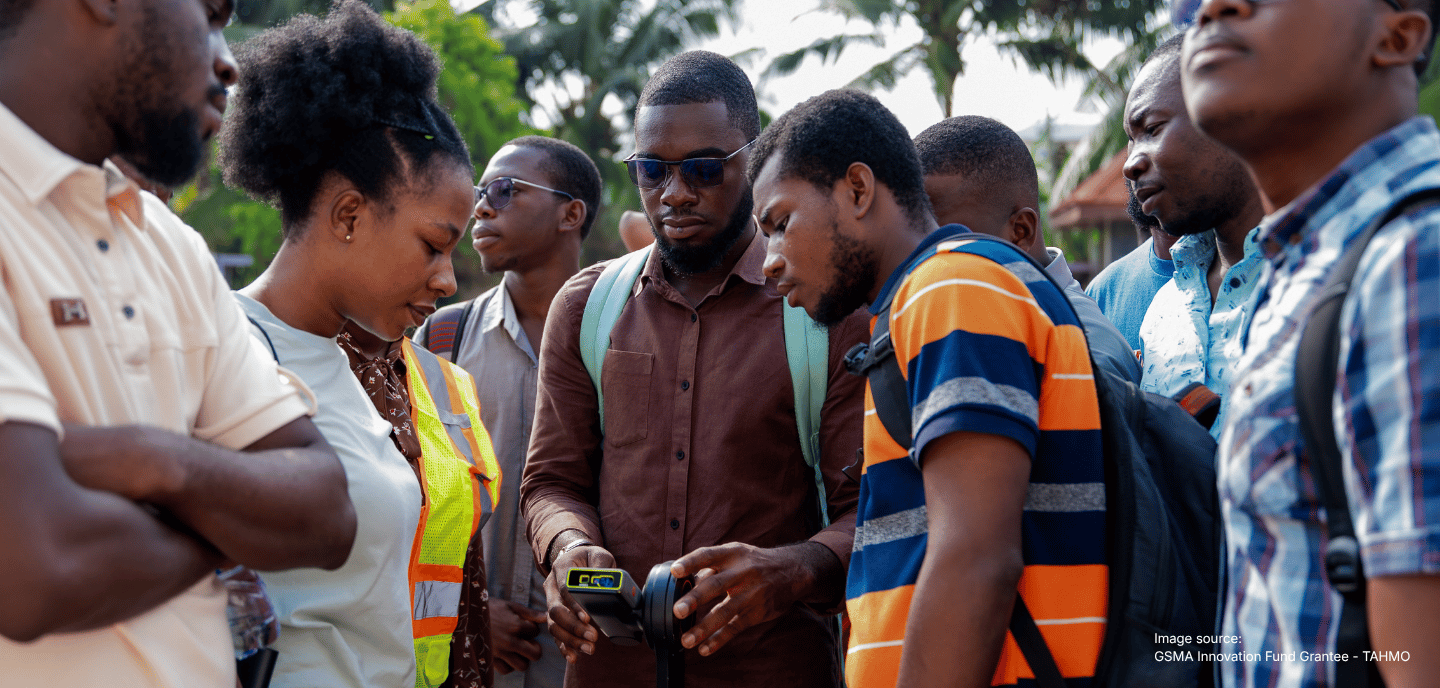
In 2025, the M4H team supported three rounds of innovation funding across differing cycle stages, with early warnings emerging as a recurring theme. In March 2025, eight grantees from the GSMA Innovation Fund for Anticipatory Humanitarian Action closed out their projects, including a number aimed at flood preparedness. Case studies and a learning paper document the lessons and achievements of each project.
Throughout 2025, the GSMA Innovation Fund for Humanitarian Challenges continued to support grantees, ranging from small for-profit enterprises to startups and local innovators. The portfolio supports a range of humanitarian innovations, from early warnings, health tech, financial inclusion and WASH solutions. Africa-based grantees were invited to attend the Innovation Fund bootcamp in Nairobi in February, and Asia-based grantees were invited to attend the bootcamp in Singapore in May. Both bootcamps provided exposure to investors, learnings and briefings on cross-cutting topics, and networking opportunities with peers.
The GSMA Innovation Fund for Humanitarian Replication and Scale launched in November 2025. This fund aims to support the scaling of humanitarian innovation beyond the pilot phase. Early warnings prevailed as a key theme for the six grantees chosen for the portfolio, all of whom were GSMA Innovation Fund alumni.
Responsible use of mobile data in humanitarian contexts
In 2025, the M4H programme commissioned a strategic landscape study on the responsible use of mobile data in humanitarian contexts. The research examines how different types of mobile data are currently being applied, analyses the incentives and risks shaping MNO and humanitarian collaborations, and identifies opportunities to advance impactful partnerships.
By addressing these questions, the study aims to build a more grounded and practical understanding of how mobile data can be used both responsibly and effectively to support stronger humanitarian outcomes. The research will be published in 2026.
Putting inclusivity at the centre of our approach
Connectivity does not benefit everyone equally, and our work continues to focus on understanding barriers to inclusion and how to overcome them.
While M4H continued our efforts to deliver sustainable and impactful market engagement projects across five countries (Burundi, Somalia, Tanzania, Uganda and Nepal), we started to map the humanitarian landscape and industry priorities of five additional countries (DRC, Ethiopia, South Sudan, Mozambique and Chad). This included conducting high-level market assessments, delivering cash and voucher assistance (CVA) at scale, the use of voice ID technology for the delivery of humanitarian assistance, increasing financial literacy in crisis-affected communities, and exploring the possibility of using mobile money agents as disaster risk reduction champions.
M4H is partnering with Twilio to support a partnership between the Kenya Red Cross and Tanzania Red Cross to pilot a peer-to-peer learning project in Tanzania.
The team has published a research report on Making Early Warnings Work for All to showcase approaches to ensure inclusion in risk communication.
M4H is using a displacement-focused version of the CoNUA toolkit for the Connectivity for Refugees initiative in collaboration with UNHCR to support the inclusion of refugees in connectivity initiatives in South Sudan.
Through engagement with World Bank connectivity investments in East Africa, the M4H continued to deepen collaboration and support for refugee digital and financial inclusion, and provided high-level leadership support to the Connectivity for Refugees initiative through a joint mission to Chad’s Farchana settlement hosting Darfuri refugees from Sudan.
Expanding the reach of digital financial services
M4H expertise on digital financial services and financial inclusion continues to drive engagement in the increasingly high-profile sector.
In 2025, our humanitarian positioning work has become more practical and visible across Somalia, Tanzania, Ethiopia, South Sudan, DRC, Chad and the SADC region.
In Somalia,
our partnership with WFP deepened, building on the trust and momentum gained from earlier digital and financial literacy work with Baxnaano beneficiaries by focusing on frontline service quality. M4H trained 124 Hormuud and Golis staff on humanitarian conduct and supported this with a simple, reusable training toolkit. The Telesom-Concern Worldwide partnership moved forward to digitise savings and loans for 272 self-help groups in Somaliland, with the platform now being tailored ahead of rollout.
In Tanzania,
M4H revived the First Responder EWS collaboration with TRCS and secured Twilio’s support to launch a pilot in early 2026 in rural, disaster-prone communities. In Ethiopia, we completed a humanitarian digital market assessment and validated it with the Ministry of Innovation and Technology, working closely with the GSMA Africa Policy team and setting up a clear Phase 2 pathway.
In South Sudan,
M4H carried out a humanitarian digital needs assessment to understand what is working, what is missing, and where mobile solutions can realistically support humanitarian delivery. Operators and humanitarian agencies have been engaged through targeted interviews, and the findings will be validated with stakeholders to agree a small set of practical concepts to take forward together.
In DRC,
M4H supported the replication of a digital maternal healthcare engagement model under the Humanitarian Solutions Platform through a partnership with WFP, Vodacom Foundation, and the government of the DRC. The Make the First 1000 Days a Good Start in Life campaign combined community mobilisation with SMS outreach to promote maternal and child nutrition. By leveraging Vodacom’s network, over 14 million subscribers across six regions received targeted nutrition messages, and more than 12,000 community members were directly engaged through on-the-ground activities. The initiative demonstrated how mobile operators can support large-scale behaviour change and public health priorities in fragile contexts. It also strengthened collaboration between government, humanitarian actors, and the private sector, reinforcing the role of mobile as critical infrastructure for national development and crisis response.
Through the Digital Finance for All initiative, a partnership between the GSMA Mobile for Development Foundation and Visa, M4H completed a landscaping exercise to identify opportunities for digital financial inclusion for displaced populations in the DRC.
In Chad,
M4H strengthened collaboration between WFP Chad and Airtel Chad to advance the digitisation of cash-based transfers for vulnerable populations. Through technical support and ecosystem coordination, the partnership leveraged Airtel Money to deliver humanitarian cash assistance digitally, improving efficiency, transparency and beneficiary access. The initial pilot phase was successfully implemented, demonstrating the viability of mobile money as a scalable channel for humanitarian cash distribution in Chad.
As the partnership progresses, M4H will support the integration of digital skills and financial literacy training using the Humanitarian Solutions Platform toolkit. This next phase aims to strengthen beneficiaries’ confidence and capability in using mobile money services, ensuring safer usage, improved financial inclusion outcomes, and more sustainable impact beyond the immediate cash intervention.
In Mozambique,
key stakeholders convened for a humanitarian positioning workshop aimed at strengthening dialogue between mobile operators and humanitarian actors. The workshop provided a platform to surface operational needs, coordination gaps, and challenges faced by agencies responding to recurrent climate-related emergencies, particularly floods. By facilitating this exchange, M4H reinforced the role of the mobile sector as a critical enabler of humanitarian response and preparedness.
A tangible outcome of this engagement was the brokering of a partnership between Vodacom Foundation and UN OCHA to support emergency flood response efforts. This collaboration demonstrated the value of M4H’s convening role in aligning private sector capabilities with humanitarian needs, accelerating coordinated and technology-enabled crisis response in Mozambique.
Advocacy continued with government regulators, the mobile industry and UNHCR to expand financial inclusion for refugees in Kenya. After years of advocacy, M4H and partners’ efforts led to Legal Notice No.90 in May 2025, which recognised a valid Refugee Identity Card for SIM registration across Kenya for the first time.
The GSMA attended several events in 2025 and were able to engage with key partners, including the CALP Network and the Alliance for Financial Inclusion on the financial inclusion of forcibly displaced persons (FDPs) at its Global Policy Forum in Namibia.
We welcome the opportunity to widen our circle of partners and allies.
Please contact us at m4h@gsma.com
This initiative is funded by the UK government’s Foreign, Commonwealth & Development Office (FCDO) through its Global Research and Technology Development portfolio and the Swedish International Development Cooperation Agency (Sida), and is supported by the GSMA and its members. The views expressed do not necessarily reflect the UK or Swedish government’s official policies.